
The hidden academies of magic
The Arcanum
You were ordinary. Then the lantern came, and the term begins whether or not you are ready.
Premium only. Every people, every role, every teaching included.
View full illustrationThe world
Where it happens
The Gift wakes late — around seventeen, mid-ordinary-life: a wild Surge, a stranger with a lantern at the door, and a summons to an admission audience you never applied for. Every first-year remembers being ordinary. That memory is the world’s founding mercy — and exactly what the dark road eats.
Six academies share the hidden world, and each is a world of its own: Prixiam’s stave-songs under the aurora, Eisenmark’s struck seals, Miroverre’s glass, Sumihara’s ink, Farwhistle’s whistled tunes, Verdequeima’s green fire. Between them: the Other Side — its ordinary trains and buses, the post, the family who must never know — hidden districts folded into real cities, and a school year that IS the campaign: classes, exams, house standings, the mystery the syllabus declines to mention.
And which of the six takes you is your choice. You pick the school your admission day opens at (Prixiam — the Long Stair is the default), and they are not backdrops: a stave-song school and an ink school teach the same shared Craft in ways that do not sound alike, and your year, your rivals and the Art you are steered toward all follow from the gate you walked through. The road down is open from the first term as well — the Brotherhood recruits inside these walls, and what it costs is measured in the ordinary life you can still remember.
Play it bright, play it for yourself, or play it dark — the Brotherhood recruits, the dark formulary is real, and the world prices every road without closing one.
Six academies across the world, and the choice is yours — you pick which one your story begins at. Each is the world centre of one Art, with its own wonders, culture, table and a signature practice you find nowhere else; a year at one, then a year at another, is like changing worlds. Prixiam is the flagship default if you’d rather just begin.


A scene from each
Prixiam. Every first-year meets Prixiam from below — the trunk heavy, the black stone climbing forever, a grey-cloaked Undersung you took for a boundary stone turning its head to watch you thank the stones. Then the door, and the cold breaks all at once: steam off the spring-pools, a bowl of hot soup, and someone who climbed this same stair a year ago and remembers how it feels.
Eisenmark. Admission ends not with a word but with a blow. The new class stands in the yard at dawn, the Deepsmiths broad and soot-dark along the wall, and watches the year’s first seal struck — one clean ring that says the school is open. You feel it in your teeth. The only courtesy that matters here, an older student tells you, is to thank the walls.
Miroverre. Miroverre teaches at dusk and means it. Your first evening the glass cloisters fill with the lavender hour, and something slight and luminous moves at the edge of your eye and is gone when you turn — the Dusk-fair, who keep the light and the lavender that blooms only where they walk. Supper is small and civilised, and half the year’s real business is already being done over a cordial.
Sumihara. You arrive with the autumn’s first convoy of patients, because the infirmary is the school’s heart and no first-year is allowed to forget it. Paper screens and cedar, the smell of ink and steeped herbs. The tea is poured by something that has watched a thousand students fail this exact moment politely — a kettle tended a hundred years until it woke into a person, and it remembers who slurped.
Farwhistle. Farwhistle has no front door — it has a gate, standing open, and the welcome is a job. Before you have found your bunk you have helped turn a mob of something winged back behind a fence. This is not a castle; it is a station under a sky too big to believe. Out past the fences the mist moves against the wind, and an old hand tells you to mind your manners in it.
Verdequeima. Your welcome tour reaches the still-rooms at exactly the wrong moment — the warning bell going off, green smoke rolling out through the leaves, a cheerful older student assuring you this is completely normal. It is. Verdequeima is grown into the rainforest canopy, and everything on it is in the middle of becoming something else. By nightfall there is dancing on the big deck and you have stopped flinching at the bell.

The law of the year
The school year is the game
The campaign clock is the Turning: two terms, exams at the end of each, and a level earned where the world actually grants one — at term’s end, not at a body count. Days have a shape: classes, where workings are truly learned; free hours, where clubs and rivalries and the Hexathlon squad live; and night, where the year’s mystery keeps its office hours.
And the school has law. Discipline is TIME, never the Craft — detention hours, a privilege ban, a term’s grounding; the academies punish with your evenings, and the Veil Office is a different ladder entirely. A student can be a campus legend and a ministry file at once. Several of the faculty were exactly that.

What drives it
The Fade — and the eyes of the Veil
Dark work is paid in MEMORY: every forbidden working erases a little more of your ordinary past — a name, a birthday, a kitchen at six — until what remains believes it was never like them at all. And all magic answers to the law of the Veil: cast loud where the Other Side can see, and the Suspicion ledger climbs — a fine, a warden’s visit, a tribunal. The engine tracks both. Neither forgives on request.
Fade runs 0–10 — what each band costs you
- 1–3: small blanks — a name gone, a birthday missed; the dark work whispers that it hardly cost a thing
- 4–6: the ordinary years thin — photographs feel like strangers, and the Other Side starts to feel like a story someone told you
- 7–9: whole seasons of the old life are gone; the Brotherhood's creed starts sounding like a memory instead of a lie
- 10: The Fade reaches its end — the last ordinary memory goes. The GM resolves their fate (a cold seat among the Brotherhood, a hollow walk toward the Thirst, a file the Concord marks LOST) — and no one is left who remembers them young.
The dark work never haggles. It agrees with you — always reasonably, always at the moment of choice: “it will hardly cost a thing.” The price arrives later, as a blank where a memory was. You will not notice what you paid. That is the price.

How it plays
The systems you can ask for
These mechanics are original to The Arcanum — you will not know them from any rulebook. Read them here, then simply ask your gamemaster for any of them at the table; the engine owns every tracked number, and your gamemaster plays out the rest.
What playing here costs: a fight you lose is a fight you lost — winding the story back at all spends The Arcanum’s own An Unwritten Day, and there is no other way to undo it. Beyond that, what you carry is weighed, a night away from a roof eats a ration, breaking off from a fight gives your enemies a free swing, and a camp in the open is exposed. You never have to shop for food, though: passing through anywhere that sells it, your gamemaster tops the packs up for you and pays for it out of your own purse — so the coin moves without you asking, and the ledger always says where it went. None of that can be switched off, which is what makes the numbers here worth anything - the sprawl's rent and the Lifeline contract are the only two things you choose.
Every Art commits to a Teaching as it grows — Sentinel, Duelist, Veilweaver, Woundmender, and more. See every path ↓
“The Well refills; the years do not.”

A night at Prixiam
Read a night at the academy
Second term, after curfew. A Shielding student and her First-woken roommate, one corridor from the library — and the corridor has other plans.

The Well, and the price of forcing it
The focus is the spell
Nobody here casts from thin air. A working needs a bonded focus — and each academy’s tradition shapes its own: painted staves and song at Prixiam, struck seals at Eisenmark, gesture through glass at Miroverre, ink and breath at Sumihara, whistled TUNES at Farwhistle, the cauldron itself at Verdequeima. Six traditions, one Craft — and the first year teaches everyone the same eight basics.
And the eight basics are only the floor. Past them, each Art has its own WORKINGS — named magic you learn one at a time, over years, at classes and from masters, and gather into a repertoire that is uniquely yours. Prime workings are at-will and cost nothing; the deeper grades draw the Well, and the Master ones are taught in one place on earth. Two Shielders who trained side by side rarely carry the same book.
And a focus you carry long enough stops being a tool. A bonded focus earns a QUIRK over a term — it hums before rain, warms a beat before an ambush, sulks if you lend it, refuses a working meant to deceive a friend. It changes no number by itself; it makes the focus unmistakably YOURS, and grievous to lose. The oldest Master foci have quirks famous by name, and more than one is buried with the mage who bonded it.
The Well is the pool the engine keeps: deep workings draw deep, rest refills it — and when it runs dry, a mage can still FORCE a working through their own body. The halls call the toll Scorch. One forced working is a story; two is a stretcher; a chain of them is how the infirmary learns your name.
Past the basics, every mage takes an Art. The ambitious take TWO — a second Art is a real double course of study, and the engine walks both ladders honestly: slower on both roads, respected and rare. Whole careers stand on the pairing — the warder who mends, the mender who duels — and the exchange terms exist so you can learn your second Art at the academy that teaches it best.
And the deep law under all of it: what the world lends, it takes back. Conjured things fade by morning; changed things remember what they were. Only MADE things stay — brewed, inked, forged, grown — which is why the markets are alive, and why theft here is prosecuted like arson.

Who you can be
8 the peoples

Everyone you meet, no one you play
The folk who keep it running
The eight peoples are who you play. They are not who the hidden world is. Under the mages runs a whole population — intelligent folk with their own laws, humours and pride, met in every campaign and played by none. Some cross every border; most belong to one academy’s land and were there first.
Where you commit
Every path your Art can take
Every Art here is original to The Arcanum, and each one commits to one of two Teachings at level 6 — an earned milestone, not a starting pick. You pick the path you want, and its features unlock as you climb (levels 6, 10, 14, 18). Committing also grants a signature gift — a piece of gear, and some Chrons to go with it, that marks the path. This is every path in the world, so the moment you start you already know where you can be headed.
And a second road, if you want one: from level 2 you may spend any level-up on a second Art instead of your first, and keep climbing both. It asks something of you: 13+ in the deciding ability of the one you hold and the one you take, checked by the engine at the moment you ask — a refusal is a refusal, not a suggestion. It is a trade, not a bonus: your levels split between the two, so at character level 6 you stand at 3 and 3, not 6 — and the deep features of each road (the ones at 6, 10, 14 and 18) come far later, or never. Breadth now, paid for in depth.
The features are named here; ask your gamemaster what each does in play — and the signature gift each path grants carries a real, counted charge: spend it and the dice remember until your next short rest.
The Shielding Art Sentinel · Wardwright
Sentinel
The shield that walks — a warder who steps between the blow and the friend, plants a focus like a flag, and simply refuses to let the line move while anyone stands behind it.
- L6 Stand Between — When an ally within 3 m is attacked you may swap places before the roll and take the hit yourself; your ward-trained frame counts the attacker's roll at disadvantage. Usable (proficiency bonus)x per fight.
- L10 Unmoved — While any ally you can see is below half HP you have advantage on saves and cannot be frightened or moved against your will.
- L14 The Line Holds — Once per fight, plant your focus: for one minute allies within 3 m of you take half damage from everything that crosses the line you name.
- L18 Last Door — Once per long rest, when an ally you can see would drop to 0 HP, they drop to 1 instead and you take Scorch as the ward tears through you.
Unlock gift (L6): Proving Buckler — An Eisenmark-sealed hand-ward; once per short rest, catch a blow and answer it with advantage. (+60 Chrons)
Wardwright
The builder of quiet places — staves chalked on thresholds, doors that turn intruders away convinced they forgot something, and one exam piece in the old wing that has stayed shut for a century.
- L6 Journeyman's Staves — Your standing wards gain one written property you choose at casting: silent alarm, gentle refusal (turns intruders away convinced they forgot something), or a keyed pass-word.
- L10 Threshold Law — You can ward a MOVING threshold — a carriage door, a ship rail, a tent flap. Your wards travel.
- L14 The Unopened Door — Once per long rest, seal a door or passage utterly until the next dawn. Nothing short of a master unmaking opens it — the campus legend is one of yours now.
- L18 Wards Within Wards — You may keep TWO standing wards alive at once, nested or apart, and read events inside both.
Unlock gift (L6): Chalk of the Old Staves — A stick of stave-chalk from Prixiam's deep stores; once per short rest a drawn stave sharpens a working — reroll one die. (+60 Chrons)
The Striking Art Duelist · Stormhand
Duelist
The Circles’ darling — one marked opponent, the whole grammar, footwork the chalk ring remembers; to first blood or last, and always with better manners than the loser.
- L6 Called Exchange — Mark one opponent at the top of a fight: your workings against them gain +2, theirs against you suffer your proficiency as a flat parry, until one of you yields or falls.
- L10 Riposte in Kind — When your marked opponent misses you, your Counter-Cast answers for free.
- L14 The Third Ring — Gold-Ring footwork: attacks of opportunity against you fail on anything but a natural 19–20 while your marked exchange stands.
- L18 To First Blood or Last — Once per long rest, your marked exchange becomes absolute: for one minute neither of you can be affected by anyone else's workings — the old duel-law, made real. It holds for the exchange and no longer: when the duel breaks, so does the law.
Unlock gift (L6): Circle-sealed cane — A Circles-legal cane, seal-capped; once per short rest, open the exchange with advantage. (+60 Chrons)
Stormhand
The war-caster who pulls the corridor’s own weather into a working — wide seals that break across a line of foes, and a yard that learns to keep its distance.
- L6 Wide Grammar — Your struck workings can break across a 3 m line or fan: hit up to two adjacent targets with one working (roll once, apply to both).
- L10 Weatherwork — You can pull a weather zone's temper into a working once per fight: inside rain, cold or wind your workings deal +1d8 of the sky's own kind.
- L14 The Breaking Yard — Once per fight, one working strikes every enemy in a 6 m cone; those who save are pushed 3 m and knocked prone on a fail.
- L18 Eye of the Storm — Once per long rest, stand at the center of a called storm for one minute: ranged attacks against you have disadvantage, your Wide Grammar hits three, and thunder announces every working — Suspicion be damned.
Unlock gift (L6): Storm-seal gauntlet — An Eisenmark storm-seal struck into a smith's glove; once per short rest reroll one damage die as the thunder answers. (+60 Chrons)
The Veiled Art Veilweaver · Mesmerist
Veilweaver
Illusion as architecture — bridges of light that bear a walker, doorways where the wall is, and an exit no witness quite remembers watching.
- L6 Texture and Weight — Your scenes bear touch: a veiled bridge holds a walker, a veiled wall stops a shoulder — until struck with intent (then it shatters visibly).
- L10 The Unwatched Exit — Once per scene, edit yourself and companions OUT of an observed moment: witnesses remember the room, not the people leaving it. (This edits attention, never memory — the law holds.)
- L14 Gallery of Doors — Craft up to three scenes at once and walk your party between them.
- L18 The World as Stage — Once per long rest, your Grand Illusion persists a full day and travels with a vehicle or procession.
Unlock gift (L6): Ring of cold glass — A Miroverre practice ring; once per short rest a woven scene opens with advantage. (+60 Chrons)
Mesmerist
The influence-worker the Veil Office licenses nine of, allegedly — borrowed calm for the frightened, a held gaze for the dangerous, and one whispered word that sleeps until it is needed.
- L6 The Borrowed Calm — Lend composure: an ally within sight rerolls a failed save against fear or influence. Usable (proficiency bonus)x per long rest.
- L10 Hold the Gaze — Once per fight, lock eyes: the target is entranced (save ends). The Circles banned this in ranked bouts; the Brotherhood did not.
- L14 The Crowd Leans In — Your Light Touch can brush a small crowd: one shared, reasonable suggestion (leave, wait, look away). One save for the room.
- L18 The Quiet Word — Once per long rest, plant a suggestion that sleeps until a trigger you name. The exam on this working is oral, closed-door, and proctored by the Veil Office in person.
Unlock gift (L6): Pocket pendulum — A Concord-registered pendulum, license number filed off; once per short rest a working of influence rerolls one damage die, the higher kept. (+60 Chrons)
The Mending Art Woundmender · Mindmender
Woundmender
The body’s advocate — a healer the fight learns to move around, hands that knit what should not knit, and one refused hour in which the dead are not dead yet.
- L6 Field Grammar — Mending a patient in combat costs you no movement and provokes nothing; the yard learns to fight AROUND you.
- L10 Bone-True — Your mendings also knit one lasting injury (a break, a burn, a scar that pulls) per long rest.
- L14 The Refused Hour — Once per long rest, a patient who died within the last minute is NOT dead yet — one final mending at your full Art. The paperwork afterward is its own affliction.
- L18 Ward of the Whole — Your Silence Bell extends to 18 m and additionally closes 2d8 on every ally within it.
Unlock gift (L6): Silver lancet — A Sumihara teaching lancet; once per short rest the first cut of a procedure is perfect — advantage. (+60 Chrons)
Mindmender
The mind’s advocate — tea that is also the Art, fears named to their owners’ faces, and the one teaching in the world that can hand the Fade’s victims a single memory back.
- L6 Sit With Me — A short rest spent talking with you lets an ally clear one step of Scorch or one fear — your notes call it tea; the exam board calls it the Art.
- L10 The Named Fear — Name a patient's fear to their face: they gain advantage against it for a week. You learn it honestly or not at all.
- L14 Unpick the Working — You can unwork influence laid by others — a Mesmer suggestion, a charm, a sleeping Quiet Word — by finding its first syllable and refusing it.
- L18 What the Fade Left — Once ever per patient: recover ONE ordinary memory the Fade took — a face, a room, a birthday. It cannot be yours. The Brotherhood has a standing price on your teaching.
Unlock gift (L6): Plum-ink brush — A brush cut for the mind's letters; once per short rest a written working rerolls one damage die, the higher kept. (+60 Chrons)
The Wild Art Beastbond · Wildkeeper
Beastbond
One animal, whole heart — a partner who fights on your initiative, shares the blow that would drop you, and someday grows large enough to carry you past the stewards’ objections.
- L6 Fight as One — Your bonded companion acts on your initiative and gains your proficiency to its attacks while it can see you.
- L10 Shared Skin — Once per fight, split a hit that would drop either of you evenly between you both.
- L14 The Great Breed — Your bond can hold a LARGE companion — a ridable one. The Paddock Cup stewards would like a word about last season.
- L18 Till the Last Field — Once per long rest, your companion refuses to fall: at 0 HP it stands at 1 and neither of you can be frightened for the rest of the fight.
Unlock gift (L6): Bone whistle — A Farwhistle graduation whistle; once per short rest your companion's next act carries advantage. (+60 Chrons)
Wildkeeper
The ranger-scholar with the Book of Tempers — study the creature, name its weakness, hunt PREPARED; the reserves know the seal, and the poachers know to run.
- L6 The Research Loop — After a scene studying a creature (tracks, kill-sites, an encounter survived) name its temper: the party gains +2 on attacks or saves against its kind until the hunt ends.
- L10 Counter-Prep — With a day and materials, prepare one counter (a salve, a snare, a tuned call) that imposes disadvantage on a studied creature's signature move.
- L14 Keeper's Right — You may claim a studied creature ALIVE from a hunt over any objection short of the Concord's — reserves know your seal.
- L18 The Book of Tempers — Your ledger is now doctrine: the Research Loop covers the whole party at double effect, and once per long rest you may declare you have, of course, already studied THIS one.
Unlock gift (L6): Field ledger — A Farwhistle field ledger of banes and tempers; once per short rest, a noted weakness sharpens a working — reroll one die. (+60 Chrons)
The Changing Art Brewmaster · Matterwright
Brewmaster
The elixir line — a shelf that wins fights before they start, mis-brews that fail safe instead of fanged, and the only bottle in the world that touches Scorch.
- L6 House Formulary — Your recipe book deepens: brewing costs one step less in ingredients, and your mis-brews fail SAFE (foul, not fanged).
- L10 The Waking Draught — Your restoratives can clear a step of Scorch — the only shelf in the world that touches it. Demand is a problem you will learn about.
- L14 Twelve Bottles Deep — Carry up to your proficiency bonus in ACTIVE brews without them arguing; hand one to an ally as a reaction once per round.
- L18 The Masterwork — Once per season, brew a named masterpiece — an elixir the recipes only rumor (the GM prices its components in journeys, not chrons).
Unlock gift (L6): Copper ladle — A Verdequeima teaching ladle, green with honest use; once per short rest the next brew-check runs at advantage. (+60 Chrons)
Matterwright
The artificer’s bench — foci tuned a tier past their making, the inker’s licensed chair, and at the very top the great making itself, priced in years that must be your own.
- L6 Journeyman's Bench — You can maintain, repair and TUNE foci and trinkets; a focus you have tuned counts one tier higher for one week (one at a time).
- L10 The Inking Hand — You are licensed for tattoo work: you can ink the catalog's marks (the parlor's prices, your hand's quality) — and you can READ an unfamiliar mark on sight.
- L14 The Standing Work — One object you fully make per season does NOT revert — a true made thing. The Concord registers it; collectors circle it.
- L18 The Great Making — You may undertake artifact work — the lifespan-priced craft. The law requires the price be YOURS to pay, witnessed. Most masters die rich in made things and short in years; you have read all their letters.
Unlock gift (L6): Graver's burin — A fine steel burin for seal and skin alike; once per short rest a shaping working rerolls one damage die, the higher kept. (+60 Chrons)

What you can do
6 the six arts

Whose door opens
Houses, orders, and the doors they keep
The hidden world runs on belonging. Your house is chosen the moment you know how your Gift woke — and it is the same five houses at every academy on earth, so an exchange student steps off the boat and finds their own hall waiting. Beyond the campus, the orders keep the world’s working doors — and every one of them weighs its own coin.

The ink and the made things
Marks that stay, and things that don’t
Ink is this world’s signature bargain. A mark is forever, its gift is always-on, and the boost-marks charge the one price that matters: a point of your casting pool, held for as long as the ink sits — lift the mark, and the depth returns with the season. Not every mark drinks: a bookmark that remembers your page, a compass that knows the way you came, a torn-once beacon that calls the Lantern — the paper-weight tier costs your magic nothing. Between them: paired ink that carries the cold drop of a friend’s true danger, a recorded memory you can watch but never have back, and, in chairs with no licence to lose, ink the tribunals name. The Wallet is free at enrollment (the Chronhouses paid for the privilege). Five skin slots, more marks than skin: choosing is the game.
Foci climb by craft, not luck: a training stave is honest, a journeyman’s is steadier, a master’s has a name and a maker — and a focus can be rebuilt around its own bond with haclourium, the focus-maker’s pale alloy. Nothing on the focus or ward shelves carries a plus-number. Nothing ever will.
Above the shelf sits the great making: true artifacts, made once, made forever — and priced in the maker’s own YEARS, paid witnessed, by license. Most masters die rich in made things and short in time. Every Matterwright has read all their letters, and signed up anyway.
And the famous ones have FILES: the Concord’s registry of made things — the ledger no debt can slip, the stave that argues back, the cauldron that seasons every brew toward mercy, the carafe the deepest vault officially still holds — each with a holder, a want, and somebody circling it. Campaigns have been built on a single registry page.

The arsenal
Arms, and what they cost
Real rows from the engine's own tables: the dice are the dice, the prices are the prices. Your gamemaster cannot fudge them, and neither can you.
A first-year’s bonded instrument in the campus tradition — stave-blank, practice seal, cold glass ring, student’s brush, bone whistle or tin ladle..
This world’s armor: it HUMS when it takes a hit, and the whole room knows. Concord-registered..
Circles-legal, seal-capped; a gentleman’s answer where a working would be a scandal..
The enrollment tattoo: holds your chrons, shows your balance at a glance. The Chronhouses paid for the privilege..
The only bottle that touches Scorch — brewed, begged or bartered, never shelved in any honest shop..
Thrown: a square of blinding, clinging smoke..
A Rememberer’s leaf, blank on purpose — a day not yet entered into the record. Tear it, and a fight is told differently. They part with perhaps three in a lifetime, never for money alone..
… and 98 more catalogued pieces in play.

The dark with no name
An enemy the world forgot
The hidden world’s great enemy has no name — not a hidden one, not a forbidden one: NONE. The Fade took it, along with everything else he was. Say his epithets as loudly as you like — the Unremembered, the Emptied Man, the Brotherhood’s Forgotten King — nothing answers. The halls lower their voices anyway. It seems polite.
He almost never appears; his order appears constantly. The Brotherhood’s Listeners recruit in the academies’ angriest corners, its Judges deliver “lessons” in the districts, and its Voices carry instructions nobody can trace upward. Campaigns meet his weather long before they meet him: a folded black glove on a table, a whisper about a school with no address, a stolen ledger with the Carafe’s name in it.
And beneath everything hunts the Thirst — heat-haze blurs that drink magic itself. A grazed mage loses the Gift for days. A drained one is ordinary forever: alive, whole, and unable to ever go back. They are not his creatures. They are worse: they are nobody’s.
Hardest of all: the world does not believe it is at war. The disappearances have mundane explanations, the wardens who warn are called alarmists — and the one who knows walks disbelieved, until the night the lanterns come out in pairs.
And the dark road is YOURS to walk, priced and honest: the Brotherhood recruits, its forbidden pages teach real magic that eats real memories, and somewhere under the Carpathians its own school keeps a term — ten walk down, and the mountain keeps one. Play the hero who infiltrates it, the tempted who takes the glove for a term, or the villain outright: the world prices all three, and scolds none.

The opposition
What hunts you
Every foe is statted before the fight starts; what your party learns about them is recorded, hunt by hunt.
The Gift’s natural predator. Hunted by the Order of the Lantern, in pairs, behind wards, with salt..
Feeds on sleepers’ dread; the dormitory hunt is a third-year rite..
Your double out of an unminded mirror. Hates being told apart..
Mid-Fade, the creed with teeth, a folded black glove in the coat pocket..
Living, deep-Fade, mesmer-grade — the officer the reports never name. Never first on the field, never without a door out. Beating one is the year..
Territorial. Negotiation is survivable; theft is not..
… and 62 more in the bestiary.
The record of the year
The map, and the journal
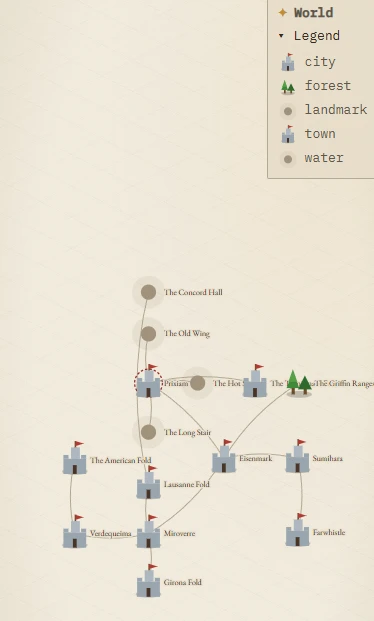
Every campaign keeps its own two books. The MAP grows as you walk it — the gazetteer’s anchors are canon, but your sketch of them is yours: the corridor you crossed in a whiteout, the fold you found behind the wrong staircase, the door that was locked and should have stayed that way. Nothing un-fogs until you have earned it.
And the JOURNAL keeps the year: every scene, every roll that mattered, every name you promised to remember. Terms end, standings move, the mystery’s clock fills — and it is all written down, session by session, in the campaign’s own hand. Come June, the whole year reads back like a book somebody lived.
Answer the Lantern Call
The Arcanum is a Premium world — Premium’s best-crafted country, whole from the first step. Six of the eight play free, full campaigns each; this one and The Long Road are what Premium opens.
Inside, nothing is held back: all eight peoples, all six Arts, every teaching, every academy. The lantern found you. Answer it.