Sword and sorcery in the Brazen Age
Serpent Throne
Win the score with steel or nerve, spend it by dawn, and never read the serpent-script aloud.
Free to explore. More character choices with Premium.
View full illustrationThe world
Where it happens
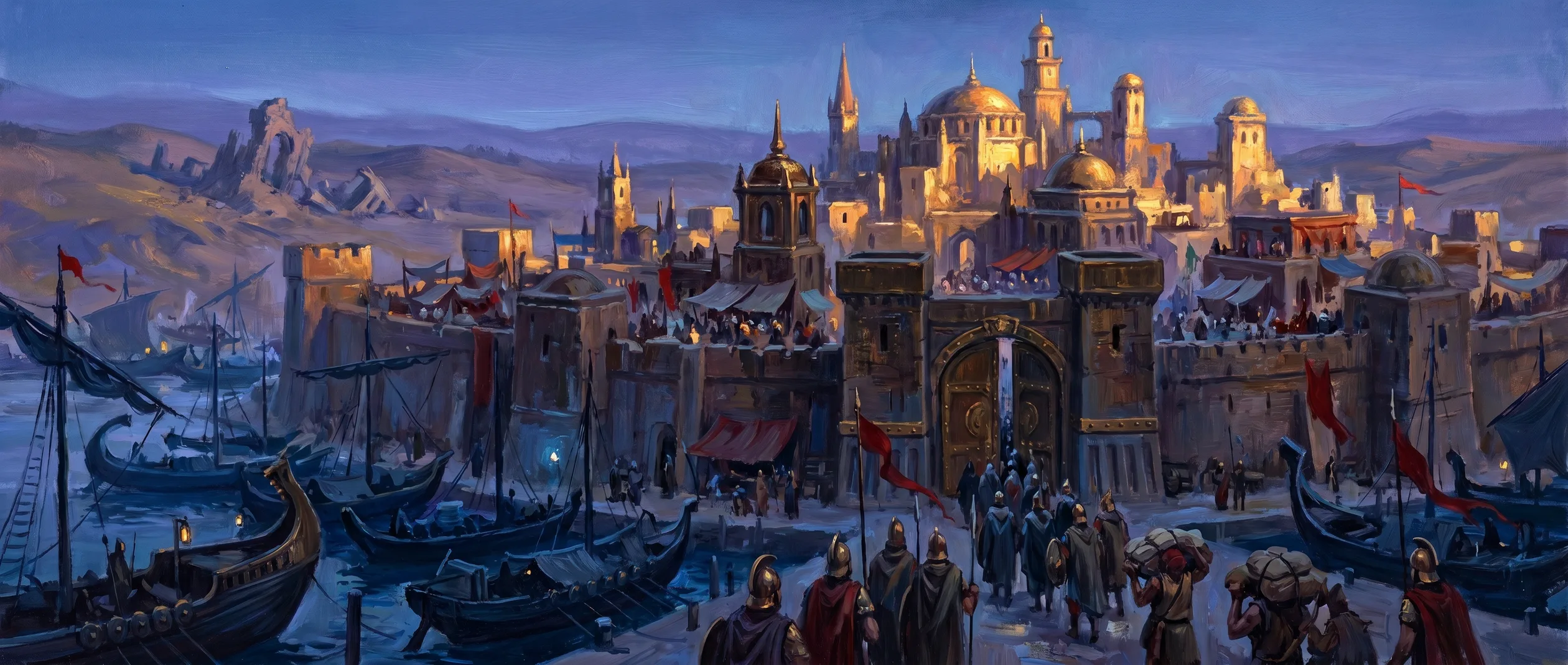
The serpent-kings’ empire fell an age ago, and the world that grew over its ruins is loud, hot and hungry: walled city-states drowning in silk and knives, a grim hill-north that bows to no one, a river empire where the old cult never died, and corsair isles living off everyone’s trade. Under it all sit ruins of something that was never human. You are a sword for hire, a roof-runner, a reaver, a corsair.
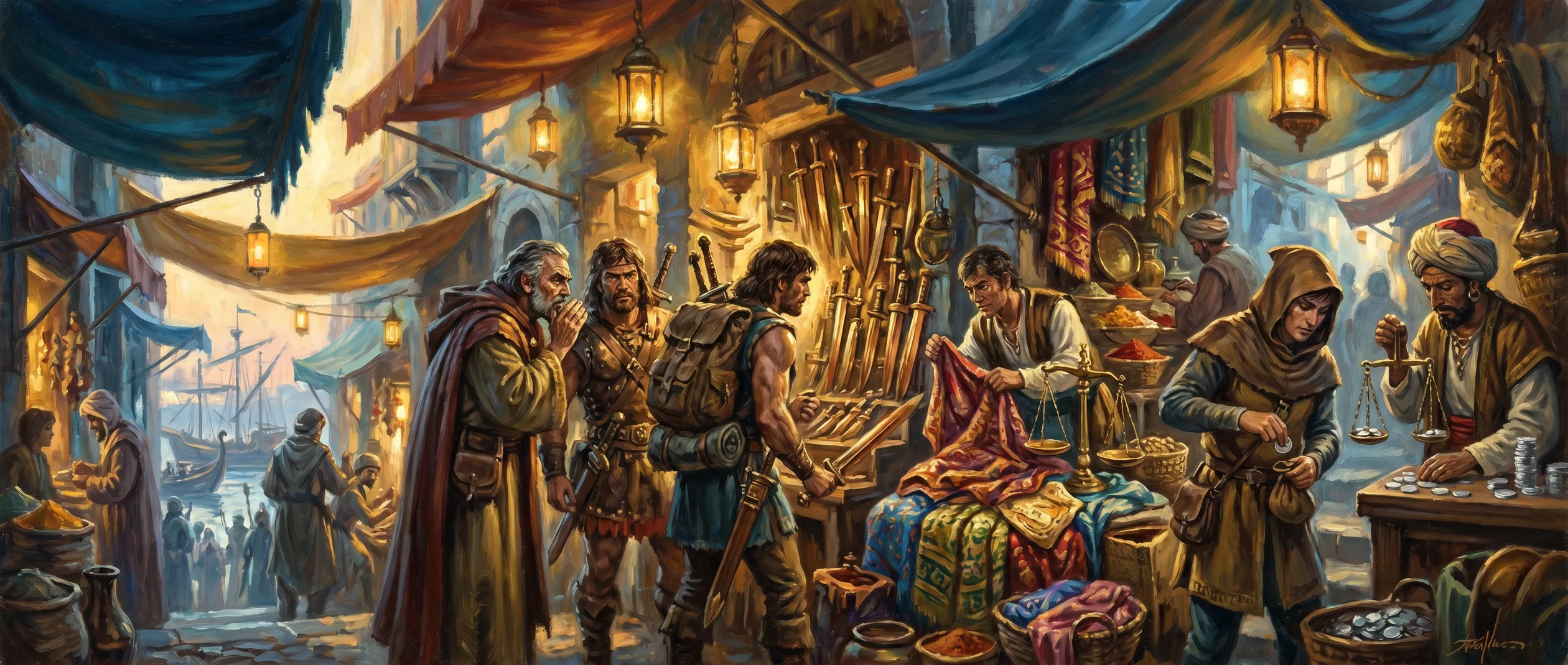
A session is a score: a tomb under the dunes, a caravan through raider country, a ransom, a prize ship taken at dawn. You win it with steel, wit or nerve, and the Spree burns the silver into contacts, reputation and tales — you wake broke, with a name that opens doors and a grudge that hunts you. Magic is real, pre-human and priced: there are no spells to cast here, only rituals, relics and bargains, and every one of them costs Doom.




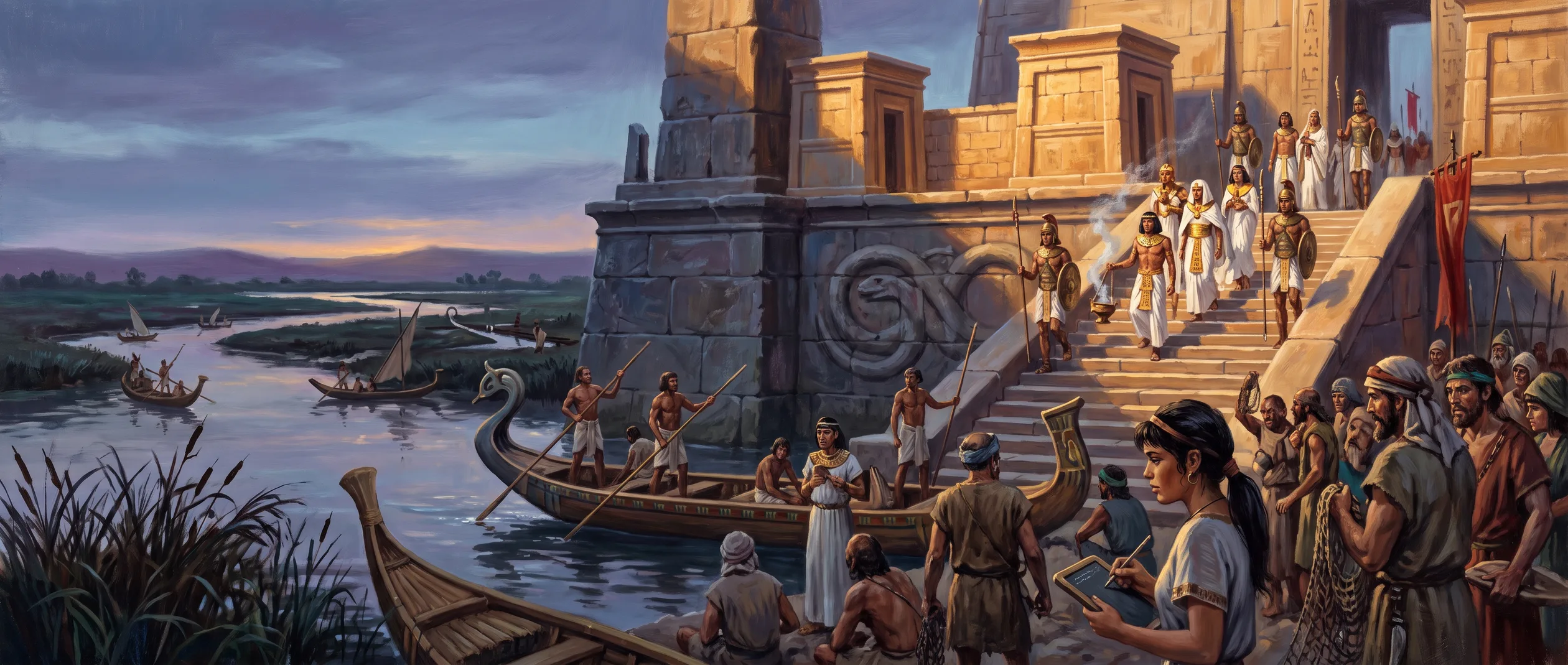

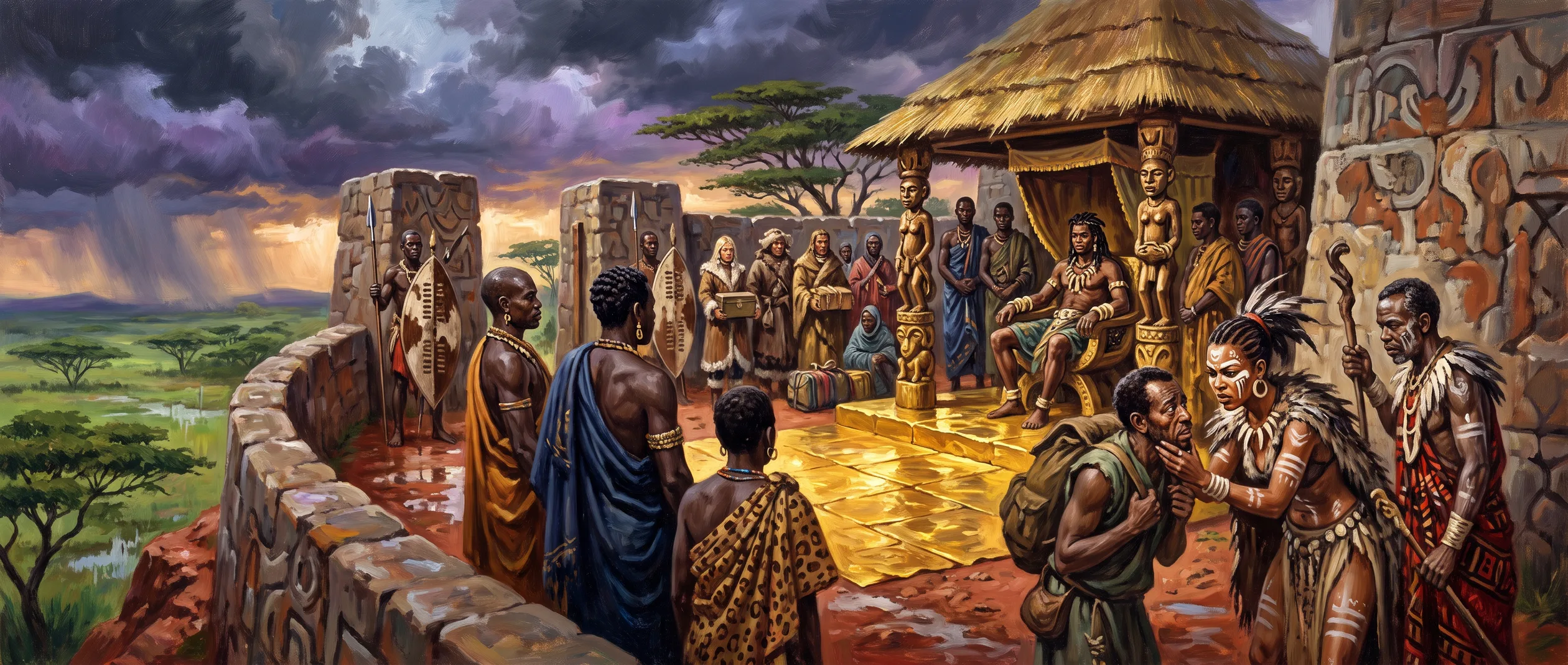
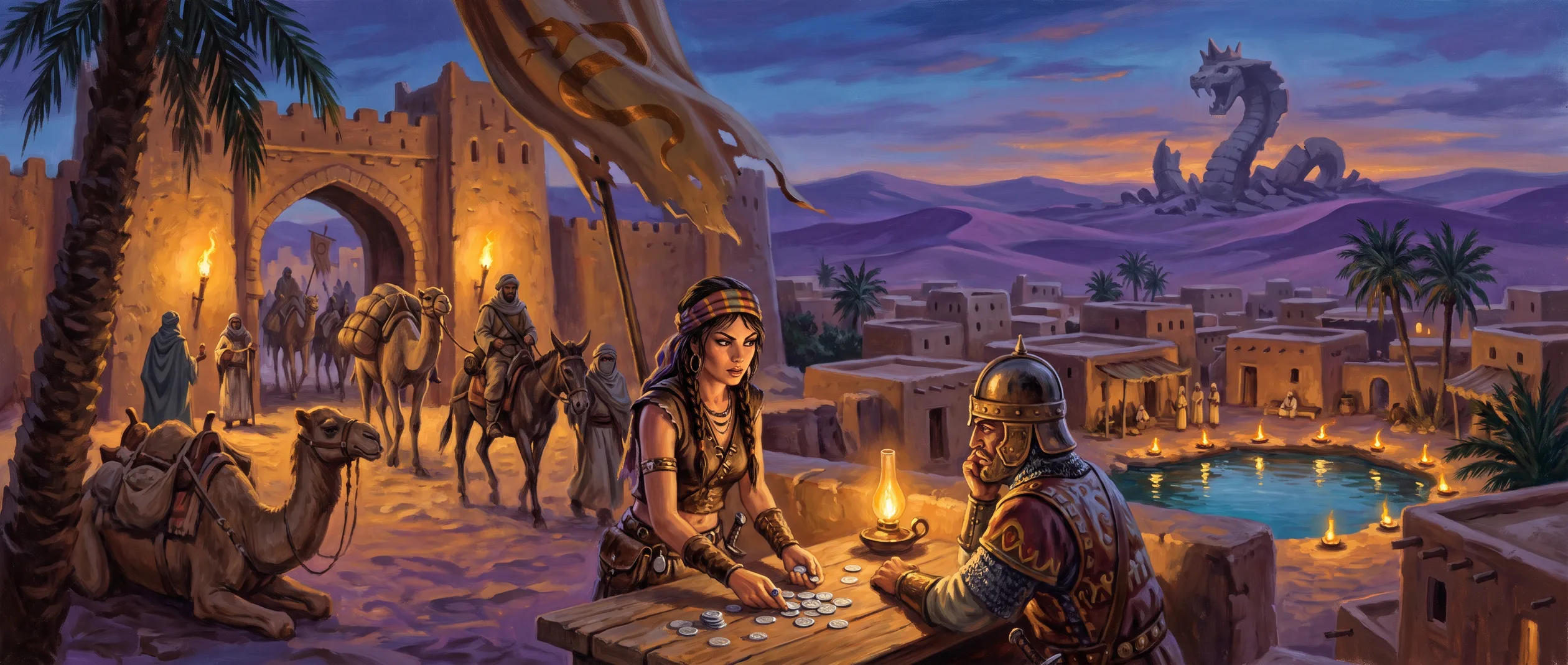
Eight lands of a wider sweep — the Skarn hills, witch-haunted Vhal and the Korvath corsair coast lie past the frame, and the far silk empire is months beyond the mountains. Distances are caravan-real: weeks of road or sail, played day by day.
And where your blade begins is your choice. Twelve lands of the Brazen Age — the whole sweep, frost-coast to lion-plains, and the desert is one region of many. You pick where your crew’s first campaign opens (Velessa of the Hundred Knives is the default); every other land is a caravan-leg away once the road runs. And the silver is not the only road: the Coil takes recruits, and a hero who joins the serpent cult keeps the character sheet and gains its rites — a chosen identity with real power, priced in Doom, never a doom the gamemaster inflicts.
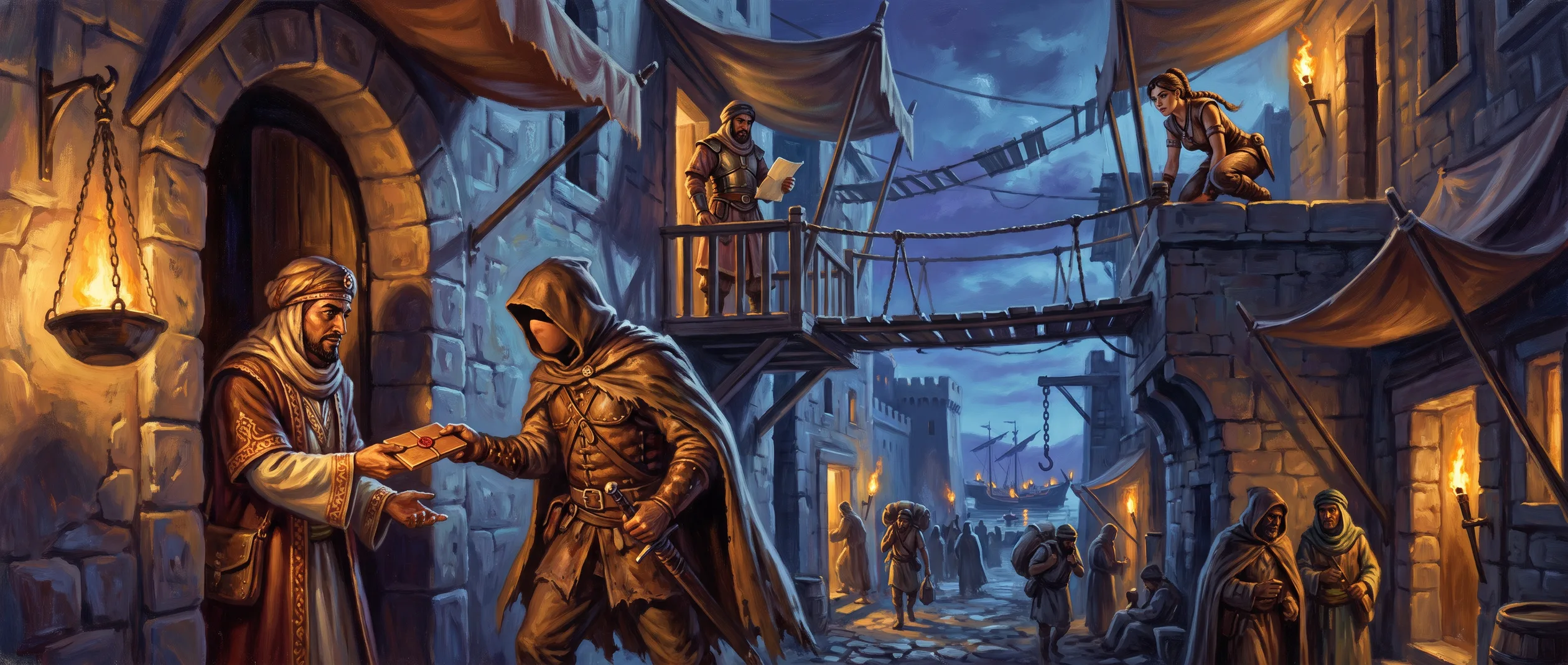
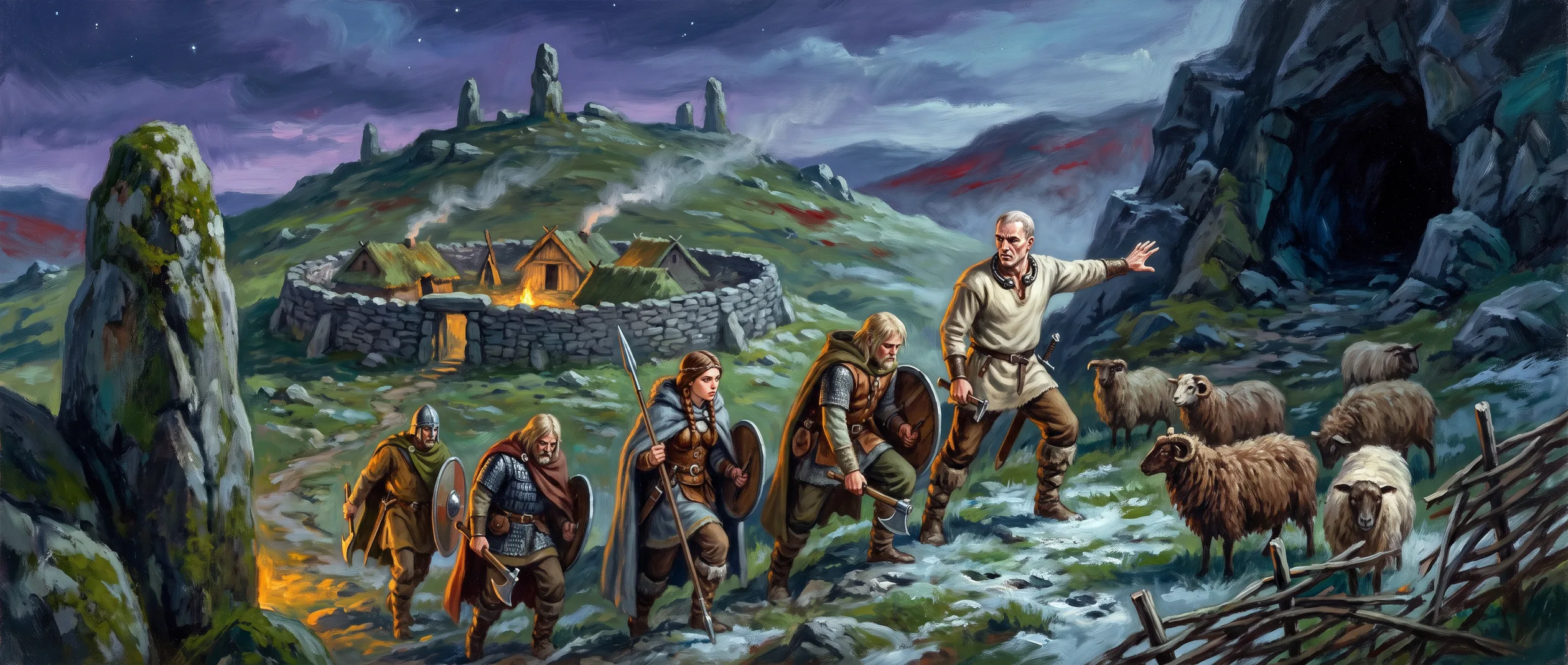

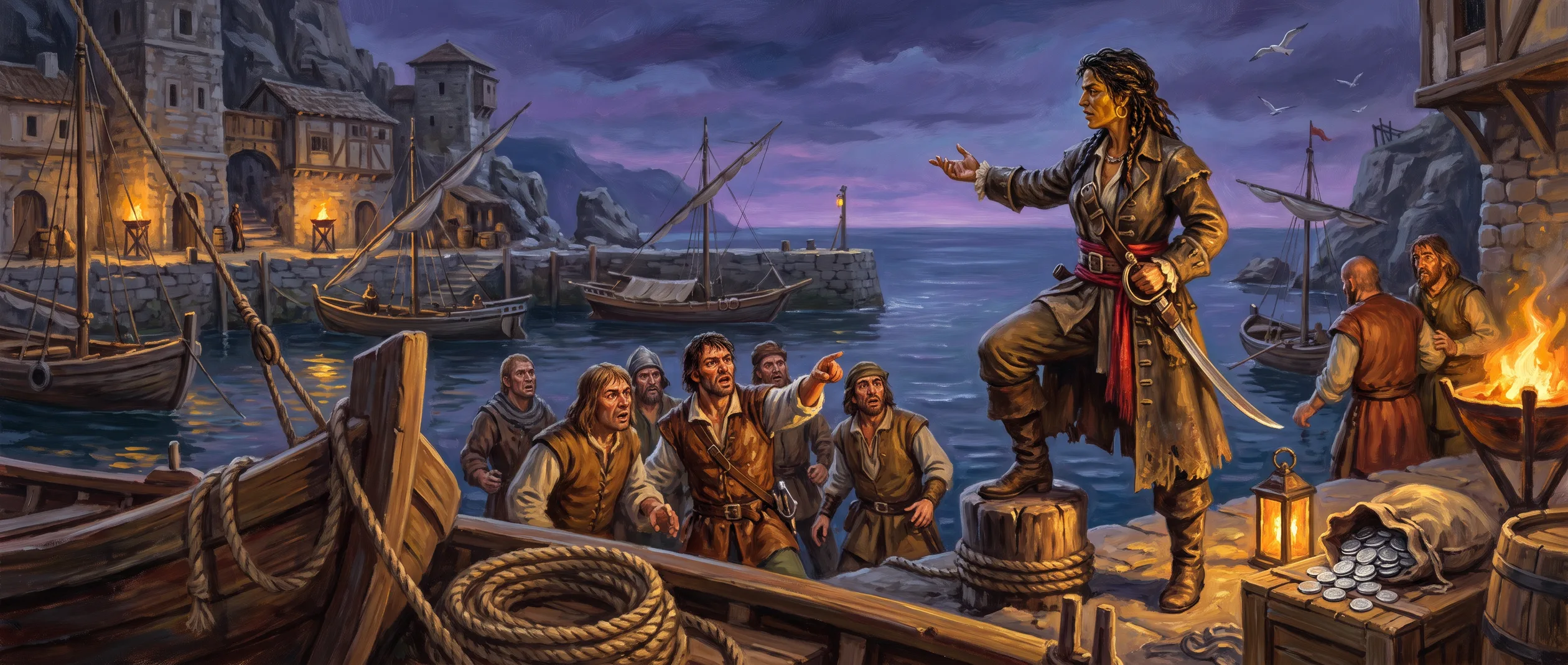

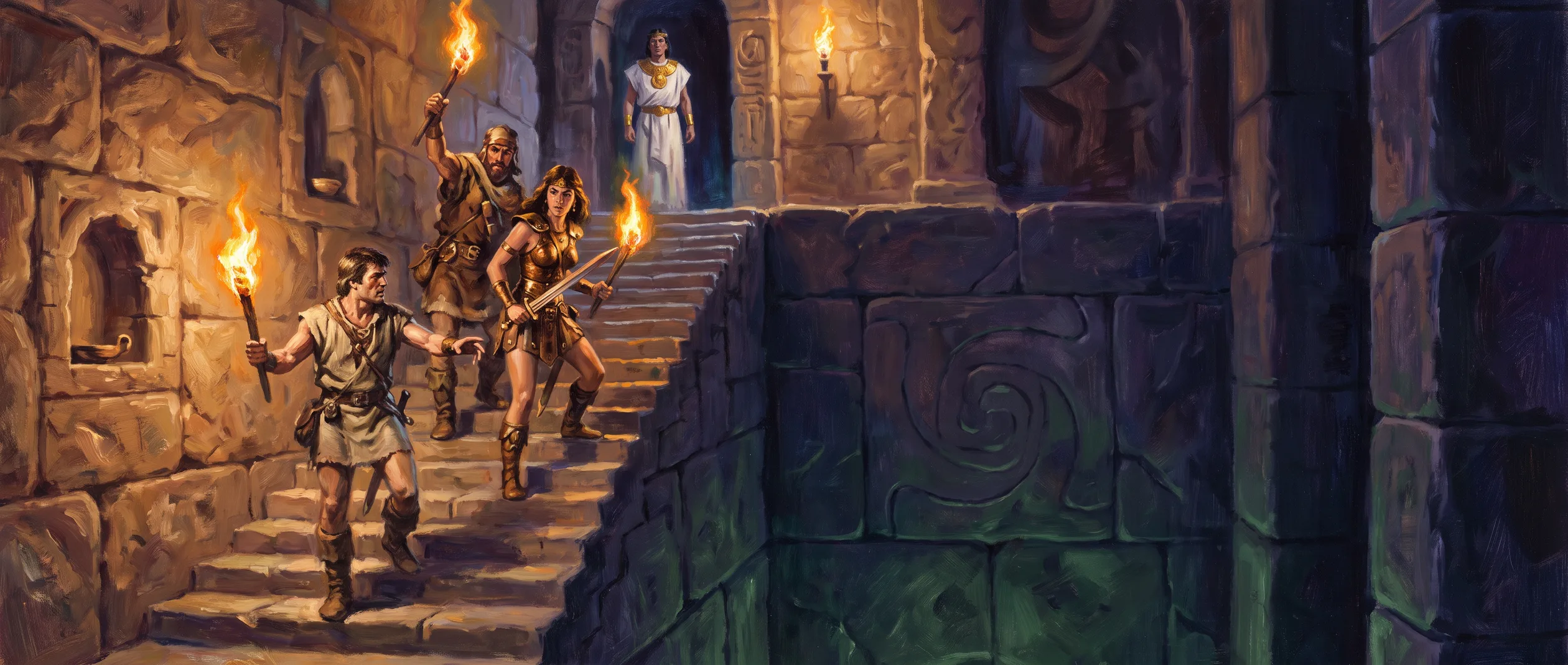
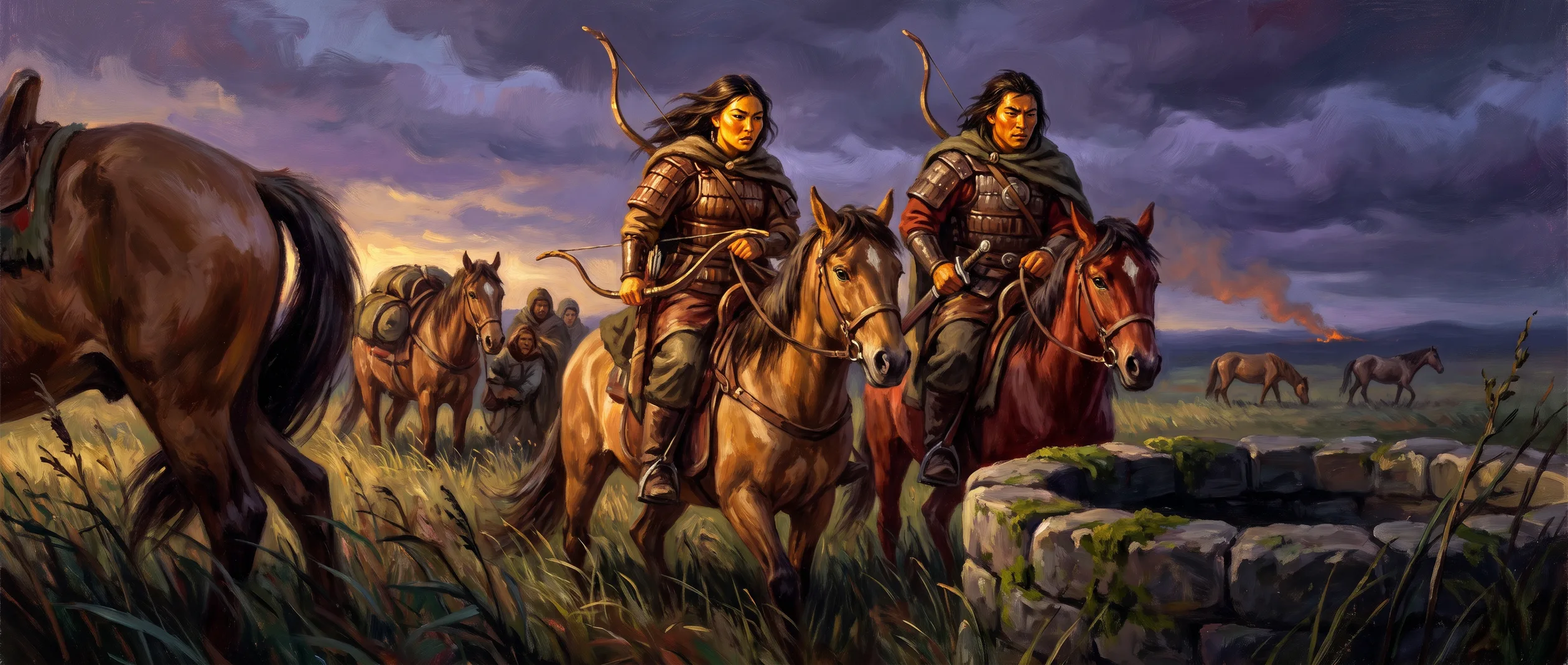


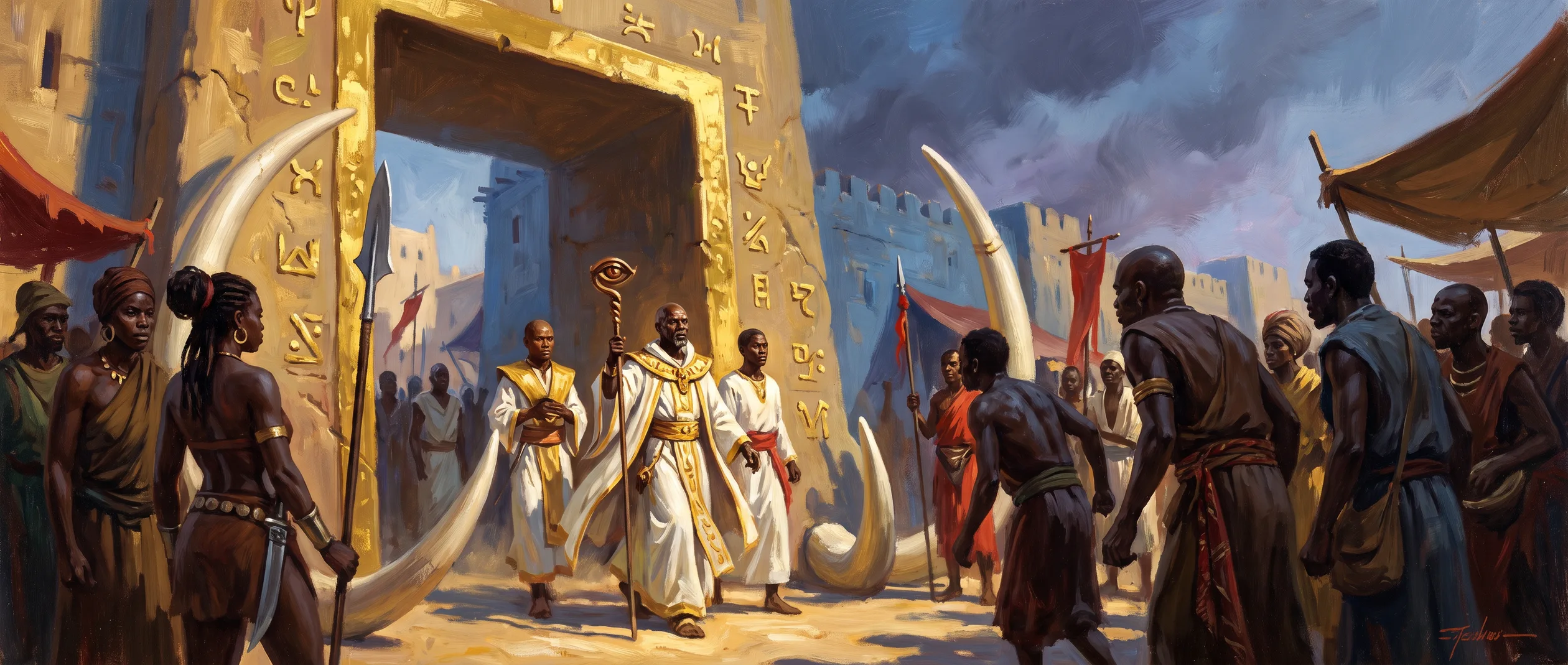
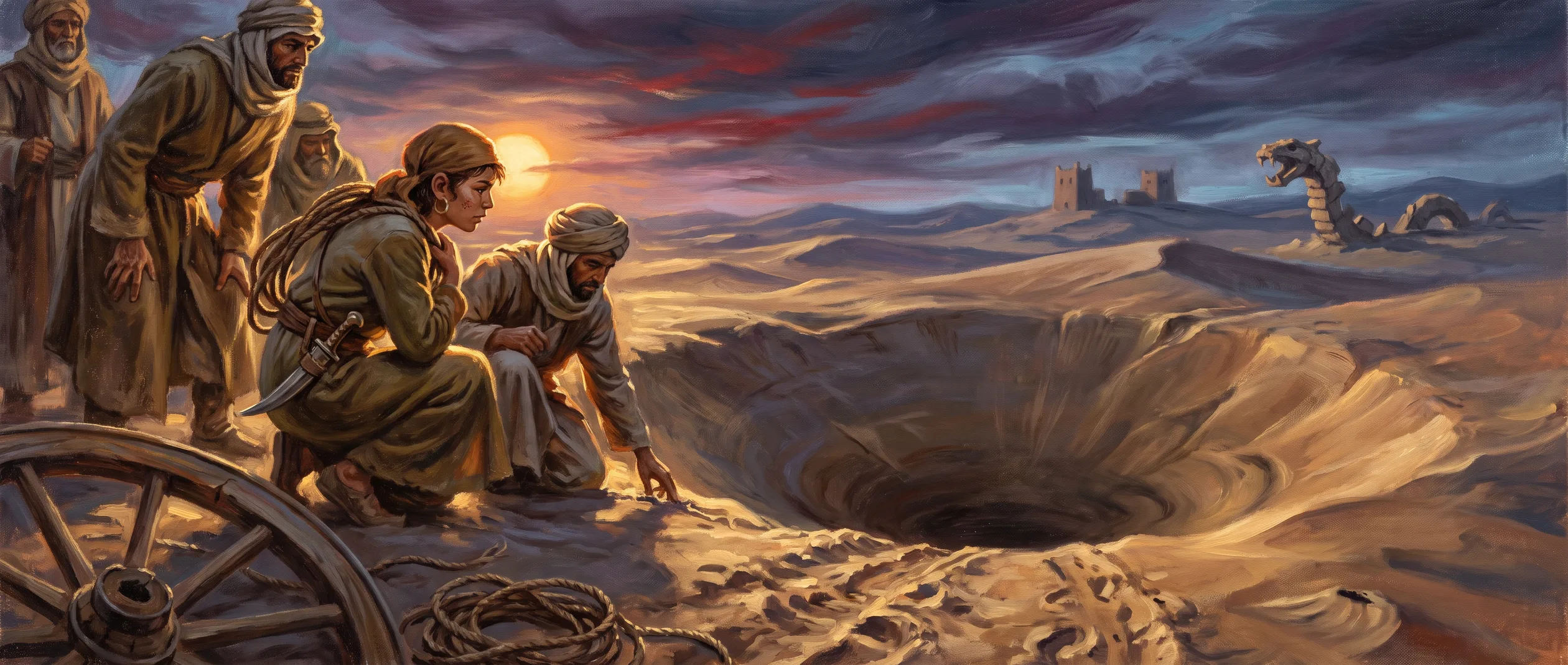

Twelve ways in — the whole sweep of the age. The dark path (the Coil’s serpent cult) is a choice reached in play, never a starting anchor.

How a crew earns
Take the score. Spend it. Wake with a name.
Wealth never accumulates in the Brazen Age — legend does. The signature loop of the sweep: take the score, win it with steel, wit or nerve, then SPEND it — the deliberate burn the age calls the Spree. A memorable night buys a contact who remembers you fondly; a week the quarter talks about buys a standing welcome at a hall; a legend buys the patron who seeks you out — and a grudge, because someone was robbed, shamed or outshone to fund it. Broke-but-famous is the trade’s resting state.
And hoarded silver itches — taxes, thieves, “friends,” the Hand’s tithe. Every big burn writes a grudge alongside the glory, and the grudge is next season’s work.
What drives it
Doom, the price of sorcery
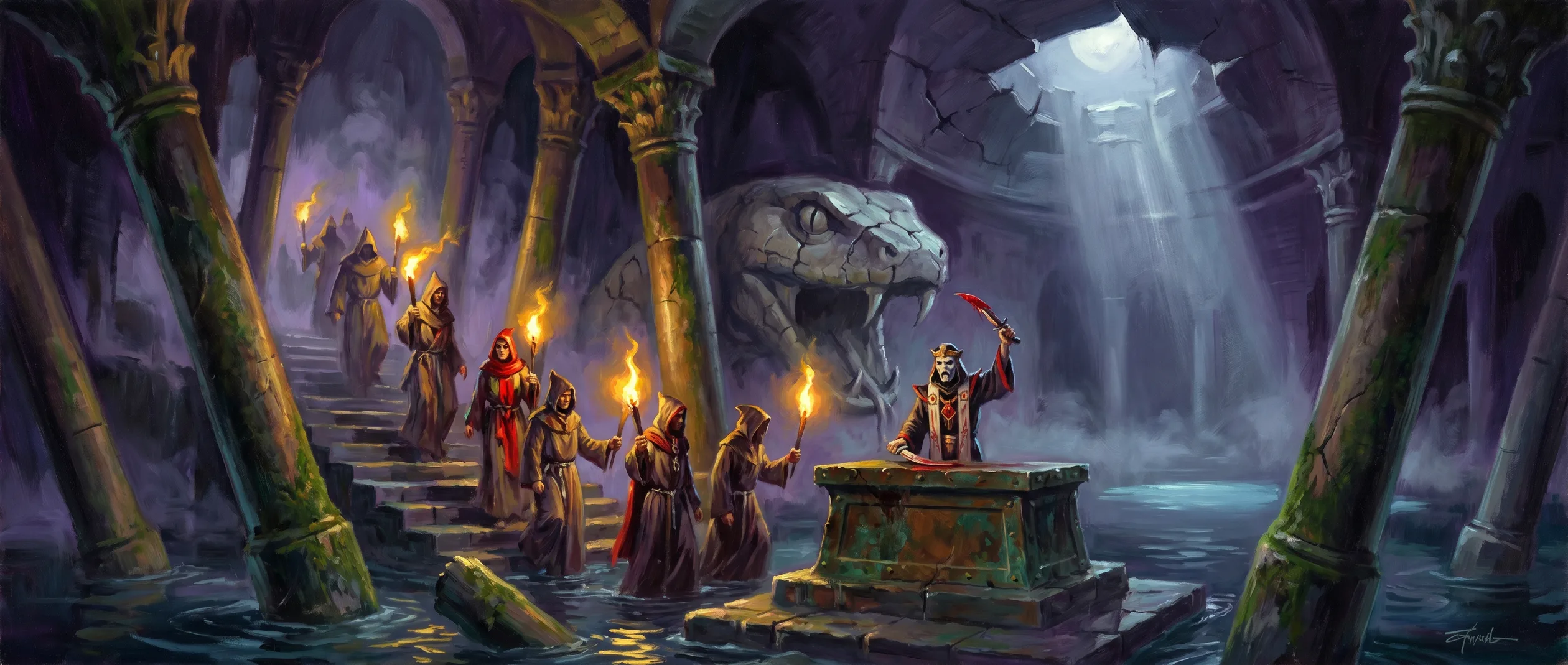
Sorcery is no trick anyone pulls off — the one who truly works the rites is the Occultist, and even their craft is slow, costly and sinister. But Doom, its price, stains anyone who reaches for the forbidden: a rite worked, a cursed relic kept, a deep ruin desecrated, innocent blood spilled for silver, the serpent-script read aloud. It runs 0 to 10 — unmarked, shadowed, marked, hollowed — and at 10 the Outer Dark claims you, and the gamemaster resolves what walks away wearing your face. There is no magical healing either: rest, bandages, a chirurgeon, grit.
Doom runs 0–10 — what each band costs you
- 1–3: shadowed — small deniable wrongnesses (milk sours, lamps gutter, dogs go quiet); a Witch-Finder who passes a check merely finds you interesting
- 4–6: marked — the dark knows your name; omens follow and the Witch-Finder's Eye reveals you from here up. Set the `doom_touched` condition as standing texture
- 7–9: hollowed — reflections lag, temples go cold, priests refuse you the rites until you purge; the ruins OPEN for you. Set `doom_touched` and let NPCs react
- 10: Doom hits 10 — the Outer Dark claims them. The GM resolves the fate (a hollow thing wearing their face, a walk into the ruins from which no one returns, a new horror NPC).
The dark charges for the call, not the answer — the price is paid whether the rite succeeds or fails. It starts small and deniable: milk sours in your saddlebag, a lamp gutters when you enter, the dogs go quiet. And the day the deep doors stop barring your way, you have become the most frightening omen in the room.
How it plays
The systems you can ask for
These mechanics are original to Serpent Throne — you will not know them from any rulebook. Read them here, then simply ask your gamemaster for any of them at the table; the engine owns every tracked number, and your gamemaster plays out the rest.
What playing here costs: a fight you lose is a fight you lost — winding the story back at all spends Serpent Throne’s own Fate-Knot, and there is no other way to undo it. Beyond that, what you carry is weighed, a night away from a roof eats a ration, breaking off from a fight gives your enemies a free swing, and a camp in the open is exposed. You never have to shop for food, though: passing through anywhere that sells it, your gamemaster tops the packs up for you and pays for it out of your own purse — so the coin moves without you asking, and the ledger always says where it went. None of that can be switched off, which is what makes the numbers here worth anything - the sprawl's rent and the Lifeline contract are the only two things you choose.
Every role commits to a path as it grows — Blood-Crowned, Shadow-Tongue, Iron Tercio, Red Wake, and more. See every path ↓
“Spend the silver tonight. The grudge keeps till morning.”

Silver, and what it costs
Read what the silver costs
What play actually feels like — one scene of a real session, gamemaster and player, every number the engine’s own.

The price of power
Nothing in this world casts
There are no wizards in the Brazen Age. There are people who do things that work and should not, and there is what doing them costs. Magic is real, pre-human and priced: it exists as rituals, relics and bargains — worked slowly, expensively, sinisterly — and every working is paid in Doom. The price is paid whether the rite succeeds or fails.
Healing is never magical here: rest, linen bandages, a chirurgeon and grit are why a crew lives. And the way back from the dark is slower than the way down — renounce and destroy the gains, make the wronged whole, live a season clean. You cannot renounce what you still profit from; selling the relic counts as keeping it, twice over.
Who you can be
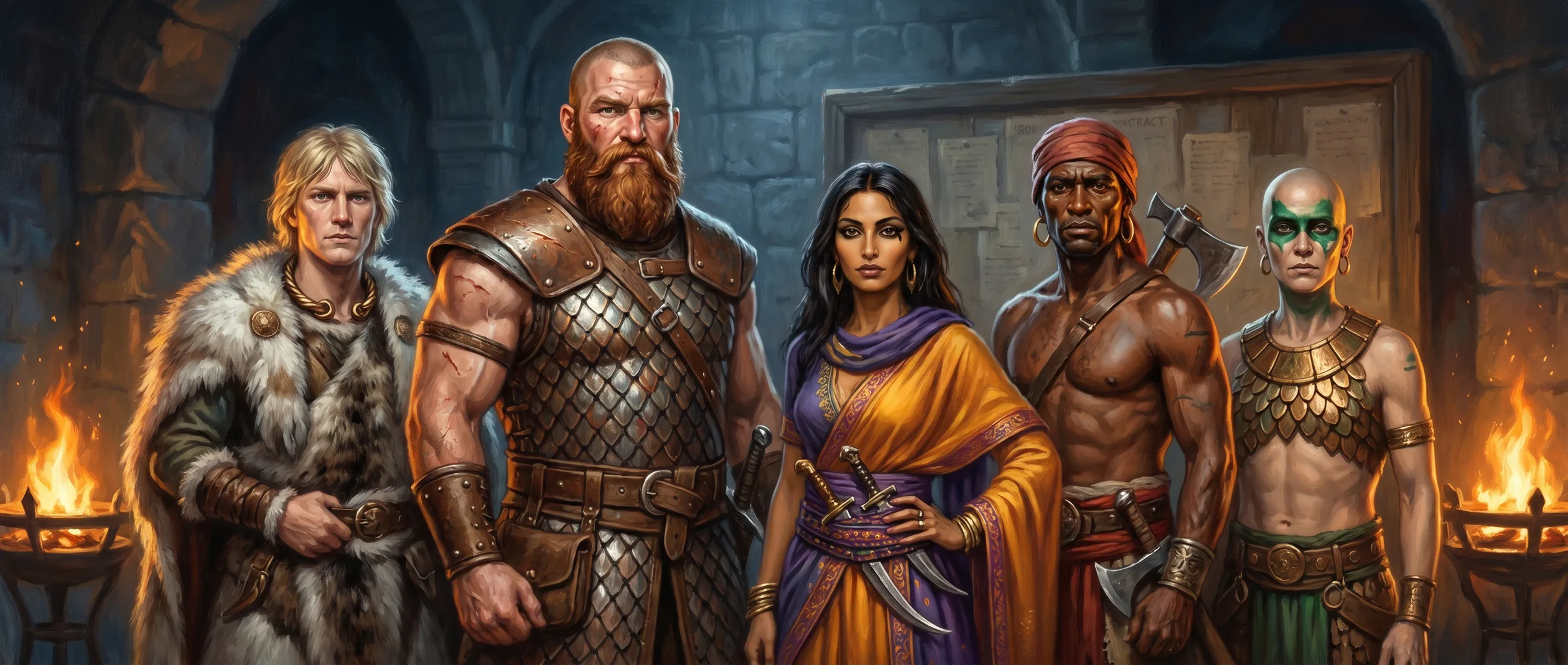
10 cultures
Where you commit
Every path your role can take
Every role here is original to Serpent Throne, and each one commits to one of two paths at level 6 — an earned milestone, not a starting pick. You pick the path you want, and its features unlock as you climb (levels 6, 10, 14, 18). Committing also grants a signature gift — a piece of gear, and some Silver to go with it, that marks the path. This is every path in the world, so the moment you start you already know where you can be headed.
And a second road, if you want one: from level 2 you may spend any level-up on a second role instead of your first, and keep climbing both. It asks something of you: 13+ in the deciding ability of the one you hold and the one you take, checked by the engine at the moment you ask — a refusal is a refusal, not a suggestion. It is a trade, not a bonus: your levels split between the two, so at character level 6 you stand at 3 and 3, not 6 — and the deep features of each road (the ones at 6, 10, 14 and 18) come far later, or never. Breadth now, paid for in depth. Blending two is a Premium feature; a single road is free and complete.
The features are named here; ask your gamemaster what each does in play — and the signature gift most paths grant carries a real, counted charge: spend it and the dice remember until it comes back.
Reaver Blood-Crowned · Iron Brother
Blood-Crowned
A warlord who feeds on slaughter, wearing a dead king’s crown — every kill he takes swells his own dread until the living break and flee before him.
- L6 Slaughter-Fed — Passive and triggered. When you spend a use of Battle-Fury, you also gain temporary HP equal to your proficiency bonus + your Might modifier (minimum 1); these last until the fury ends or your next long rest, whichever comes first. While these temporary HP remain, your first melee hit each turn deals +1d6 extra. The bonus damage ends the instant the temporary HP are spent or expire. Cost: one use of Battle-Fury (drawn from the existing pool — no additional charge).
- L10 Crown of Gore — Triggered reaction. When you drop a creature to 0 HP while your Battle-Fury burns, every enemy that can see you must pass an Instinct save (DC 8 + your proficiency bonus + your Might modifier) or be frightened until the end of their next turn. Creatures that succeed cannot be frightened by Crown of Gore again until they complete a long rest. Usable a number of times equal to your proficiency bonus per long rest; each triggering costs nothing beyond the save — the slaughter does the work.
- L14 The Red Unmaking — Action, once per fight. While your Battle-Fury burns, you call the killing-tide: until the start of your next turn your weapon attacks score a critical hit on a 19 or 20, and a creature you reduce to 0 HP cannot be stabilized by mundane means until the scene ends (a medic needs a DC 15 Instinct check to work against the tide, and nothing short of a bonesetter's table touches it). When the Red Unmaking ends, whether it expires naturally or your fury ends, you gain one level of exhaustion — the red costs what it costs.
- L18 Death Walks Behind — Passive. While at least one creature has died within 60 feet of you this fight, you are surrounded by an aura the living register in their spines: enemies that begin their turn within 10 feet of you must pass an Instinct save (DC 8 + your proficiency bonus + your Might modifier) or lose their bonus action that turn (GM: their action economy is not touched beyond the bonus action). Creatures immune to fear are immune to this effect. The aura is active only while your Battle-Fury burns; it costs no resource to maintain, but fury is still fury — it ends with the pool.
Unlock gift (L6): Crimson Circlet — A war-crown taken from a dead king; its dread turns a blow (+1 AC). (+50 Silver)
Iron Brother
A shield-sworn brother of the war-band who bleeds for the man beside him, hauls the fallen from the press, and stands unbroken when every other wall has gone down.
- L6 Shield-Wall — Passive. While you carry a shield, you and each willing ally within 5 feet of you gain +1 AC (GM folds it in; the line is a living thing). Additionally, when an adjacent ally is hit by a melee attack, you may use your reaction to interpose — the ally takes half the damage and you take the other half (round up for the ally, down for you). Using the reaction does not cost a use of Battle-Fury.
- L10 Carry the Fallen — Action. You hoist a downed or incapacitated ally weighing no more than twice your own weight and move with them at full speed without penalty — the weight is nothing to a man who has dragged brothers out of shield-walls. If you carry them clear of combat (or carry them while using Battle-Fury) they stabilize automatically at 1 HP at the moment you set them down safely. Usable once per fight, recharging on a short or long rest.
- L14 War-Band Bond — Passive. Choose a number of willing companions equal to your proficiency bonus when you begin a fight — these are your sworn band for the duration. While any sworn band member is within 30 feet of you and at least one of their HP remains, you have advantage on death saving throws, and they each gain +1 to their first attack roll each round. If a sworn band member is dropped to 0 HP while within 30 feet, you may immediately spend one use of Battle-Fury as a reaction (no action cost) to activate your fury early.
- L18 Last Wall Standing — Passive, with triggered effect. When you are the last member of your sworn band (or party) still standing — all others downed, fled or captured — your fury becomes inexhaustible for the remainder of the fight: Battle-Fury no longer costs a use and does not need to be reactivated if it ends; you simply remain in it. While Last Wall Standing is active, you take half damage from nonmagical bludgeoning, piercing, and slashing damage. When the fight ends, whether by victory or surrender, you immediately gain two levels of exhaustion (the wall held — the man behind it pays). This feature activates once per long rest.
Unlock gift (L6): Shield-Brother's Oathblade — Sworn over a comrade's grave; once per short rest, reroll one damage die while an ally is within 5 feet. (+40 Silver)
Thief Shadow-Tongue · Dust-Walker
Shadow-Tongue
A silver-tongued con who owns a room before he's drawn a blade — trading in lies, leverage, and the buried debt of every magistrate, that turns a city's underworld to his hand.
- L6 Silver Lie — Passive and triggered. You may attempt a deceive check to lie to a creature as a bonus action rather than an action. Additionally, the first time you tell a lie to any given creature in a scene, you have advantage on the deceive check; their first impression of you is the one that sticks, and you spend it well. Usable (proficiency bonus) times per scene, recharging at the start of each new scene.
- L10 The Long Con — Scene-level feature. Over a single scene of interaction (a negotiation, a banquet, a patrol walk) you may run a layered deception — each successful deceive check you make this scene builds on the last. After three or more successful deceive checks against the same target in one scene, the target is Convinced: they believe one falsehood of your choosing (GM-gated for scope — it must be something they COULD believe given what they know). A Convinced target does not re-examine the falsehood unless given hard physical evidence, though they may attempt a Cunning saving throw (DC 8 + your proficiency bonus + your Agility modifier) once per session; on a success the doubt creeps in and the falsehood no longer holds. Usable once per settlement visit or equivalent opportunity; if you fail a deceive check during the chain, the scene's stack resets (you may try again, but the target is now wary: advantage on their next Instinct save against you this scene).
- L14 Gutter Politics — Once per session, passive plus triggered. You know how Velessa's underworld — and every city with one — runs its favors: who holds paper on whom, who owes the Veiled Hand, which magistrate is bought. Declare a named NPC in the current city: the GM tells you ONE lever — a debt, a secret, a hunger — that could turn them (GM answers honestly). Additionally, when you use this lever in play, your next persuasion or intimidation check against that NPC has advantage. If you reveal the lever publicly (burning it), the target is shamed or compromised — that is a story beat, not a mechanical effect, and it is permanent. Once per session; the lever expires unused at the next session.
- L18 Voice That Owns the Room — Action, once per scene. When you speak to a group of ten or fewer people who can hear and understand you, every member of that group must pass a Presence save (DC 8 + your proficiency bonus + your Agility modifier) or be Held: for one minute they take no hostile action against you, and any social check YOU make against a Held member has advantage. On a successful save a target is unaffected and knows something unnatural was tried — that is a story consequence. Creatures actively fighting you have advantage on the save. The effect ends for a target if you or your allies attack them. Once per scene; if you spend a full downtime action preparing and seeding your reputation in a city first (GM-gated), the DC rises by 2.
Unlock gift (L6): Whisperer's Cowl — A hood that swallows your voice; once per long rest, gain advantage on a Stealth or Deception check. (+40 Silver)
Dust-Walker
A roof-ghost of the high city who lives on ledges and rigging the watch never check, leaving no footprint and no shadow, gone like smoke before the alarm is even cried.
- L6 Roof-Ghost — Passive. You move across rooftops, ledges, rigging and crumbling cornices without triggering opportunity attacks — the city's edges are your road and the watch's eyes never find the edge. While in an elevated position (at least 10 feet off the ground), you have advantage on stealth checks and may hide as a free action (no action cost) as long as you are not directly observed; once hidden up high, pursuers on the ground must beat a perception check (DC 8 + your proficiency bonus + your Agility modifier) to spot you even if they know roughly where you are.
- L10 Gone Like Smoke — Reaction, triggered when you are targeted by an attack or a harmful effect that requires a save. Before the attack roll or save is resolved, you may spend your reaction to move up to half your speed without provoking opportunity attacks — if this movement takes you out of the attacker's reach or line of sight, the attack or effect misses automatically. Usable (proficiency bonus) times per fight, recharging on a short or long rest. If you are in an elevated position when you use this, the movement is silent and leaves no visible trace.
- L14 The Vertical City — Passive plus once per scene active. You have internalized the city's third dimension: your movement is never reduced by vertical surfaces, and you may move along walls for up to 20 feet without a check (beyond that, a standard athletics check applies). Once per scene, declare a rooftop or elevated point within 300 feet that you have laid eyes on this scene — you arrive there at the start of your next turn, having used the drain-pipes and the eaves the watch never check. The GM may rule this impossible in a ruin or a place with no connected structures (and that itself is information worth having).
- L18 Leave No Shadow — Passive plus triggered, once per session. You do not leave footprints in dust, disturbed thatch or wet stone if you choose not to — no mortal tracker, however skilled, can follow your path. Additionally, once per session, after a completed theft, infiltration or escape in a scene where no named NPC saw you directly, declare you left nothing: no blood, no dropped coin, no impression. The GM honors this — the scene happened as it happened, but the physical evidence simply is not there. A named investigator on the case may attempt a Cunning save (DC 8 + your proficiency bonus + your Agility modifier); on a success a single thread survives. A witness who SAW your face still knows your face.
Unlock gift (L6): Ghost-Step Wraps — Cloth-wound soles off a dead climber's kit; once per long rest, take the high road for an hour — tile, rigging, ledge and rubble are level ground to you, and nothing below hears a step. (+40 Silver)
Sellsword Iron Tercio · Blade-for-Hire
Iron Tercio
A disciplined pike-and-shield soldier who makes a wall of bronze with the men beside him — breaching gates, holding the line unbroken, and dying on his feet so the formation stands.
- L6 Locked Shield — When you ready your shield and stand within 5 feet of at least one ally who also bears a shield, both you and that ally gain +2 AC (stacking with Formation Discipline) — the bronze wall is the weapon. As a reaction, when a creature you can see hits an adjacent shielded ally with a melee attack, you may interpose your shield: the ally takes half damage from that hit. You may use this reaction (proficiency bonus) times per fight, recharging on a short or long rest. _(GM-APPLIED - the +2 AC depends on where you and your shield-bearing ally are standing, so the gamemaster applies it.)_
- L10 Siege-Master — You have advantage on Might (STR) checks to batter, breach or bar a fortified position — a gate, a portcullis, a barricaded door — and on checks to direct other fighters in a formed assault. Once per scene, when your side storms a defended threshold in a fight (a gatehouse, a breached wall, a barred room), you may call the assault: all allies who move through that threshold this turn have advantage on their first attack roll. Nothing about leading the breach comes cheap — calling the assault costs you your bonus action this turn.
- L14 Unbroken Line — While you have a shield equipped and at least two allies are within 10 feet of you, you and each of those allies are immune to the frightened condition and cannot be forcibly moved by any nonmagical shove, grapple or bull-rush. In addition, once per turn when an adjacent ally would be reduced to 0 HP by a melee attack, you may expend your reaction and 1d10 HP (rolled, not free) to place yourself between them: you take the excess damage instead and the ally drops to 1 HP. This costs your reaction whether or not the ally survives.
- L18 The Wall That Holds — When you make your last stand — beginning your turn at half maximum HP or fewer — the formation finds its iron: you and every ally within 10 feet gain resistance to bludgeoning, piercing and slashing damage from nonmagical weapons, and your AC increases by 2 (stacks with Formation Discipline and Locked Shield). This fortitude lasts until the start of your next turn; you can call on it a number of times equal to your proficiency bonus per long rest. Additionally, once per scene you may plant your standard and issue the command Hold the line as a bonus action: every ally within 30 feet who can hear you clears the frightened condition and may immediately spend their reaction to make one melee attack against any creature within reach. The command cannot be issued again until you complete a short or long rest.
Unlock gift (L6): Pike of the Tercio — A disciplined company's pike; once per short rest, reroll one damage die while you hold formation with an ally. (+40 Silver)
Blade-for-Hire
A professional killer who takes a name for coin and never forgets it — reading the contract behind the contract and delivering the killing stroke with a craftsman’s cold precision.
- L6 Employer's Measure — When you accept a contract, mark, or named quarry from a patron — or designate one yourself at the start of a scene — that target is your Measure. Once per turn, your melee attack against the Measure deals an extra 1d6 damage, and you have advantage on Instinct (WIS) perception checks to track, anticipate and locate them. You may hold one Measure at a time; declaring a new one ends the old. If the Measure surrenders, flees, or is reduced to 0 HP, the designation clears automatically.
- L10 Read the Contract — Your professional eye reads an employer before you sign. Once per scene, when you assess an employer, patron, or anyone offering you a commission — whether by direct conversation or by observing their conduct — you may ask the GM one question from the following list and receive an honest answer: Is this person likely to betray the crew? What are they NOT telling us about the job? What would they pay if pressed? For the rest of that scene you also have advantage on Presence (CHA) persuasion and Agility (DEX) deception checks to renegotiate a contract with them when circumstances have materially changed in your favor.
- L14 The Killing Stroke — Once per turn, when you hit a creature designated as your Measure with a melee weapon attack, you may declare the Killing Stroke. Roll your weapon damage dice twice and take the higher result; if the target has 30 or fewer HP remaining after the hit, it must succeed on a Vigor (CON) save (DC 8 + your proficiency bonus + your Might modifier) or be reduced to 0 HP outright — the wound is professionally placed and the count is done. Whether the save succeeds or fails, you cannot use the Killing Stroke again until you complete a short or long rest.
- L18 Worth Every Coin — When you drop a creature designated as your Measure to 0 HP, you may immediately declare a new Measure as part of the same action — the ledger clears and opens on the next name. In addition, when you complete a contracted job (the GM determines when the terms are met), your professional reputation precedes you: for the next 24 hours you have advantage on persuasion and intimidation checks with anyone who has heard of the deed, and the GM applies a 10% upward adjustment to any silver payout you negotiate directly. Lastly, once per scene, you may spend a bonus action to size up a single creature: the GM tells you whether the target is worth more alive or dead to any current contract, and how many HP remain in rough bands (Healthy / Bloodied / Near Death).
Unlock gift (L6): Contract Saber — Notched once per paid job; once per short rest, reroll one attack's damage die. (+40 Silver)
Corsair Red Wake · Free Captain
Red Wake
A fire-and-terror reaver whose boarding actions break a crew's nerve before the blades meet — every port has seen what he does to ships, and dreads his colours on the horizon.
- L6 Fire and Terror — When you board an enemy vessel or storm a defended position, you may light a fire-pot (a thrown weapon, range 20/60 feet, Agility attack, 2d6 fire damage on a hit; cost: 1 fire-pot from gear) as part of the action used to enter, without consuming an additional action. Additionally, when any enemy aboard a vessel you are actively boarding takes fire damage, every other enemy on that deck must succeed on a Presence (CHA) save (DC 8 + your proficiency bonus + your Presence modifier) or be frightened of you until the end of their next turn.
- L10 The Burning Prize — When you capture or destroy a vessel, its surviving crew must immediately make a morale check: a Presence (CHA) save (DC 8 + your proficiency bonus + your Presence modifier) or surrender outright — they have seen what you do to ships and do not fancy becoming the next example. If three or more enemies fail this save in a single fight, the combat ends and the prize is taken without further blood; the GM applies the result via narrative. Once per prize engagement, you may also declare one building, ship, or defended structure as the Burning Prize: allies attacking targets defending that location deal an extra 1d4 fire damage on hits until the structure falls or the fight ends.
- L14 Dread Flag — Your colors alone thin the blood of coastal men. When your vessel is visible and your flag is raised at the start of a sea-fight or boarding, every enemy crew of cutthroat-tier or below must make a Presence (CHA) save (DC 8 + your proficiency bonus + your Presence modifier) or spend their first turn in a state of terrified hesitation — they may not move toward you or make attacks against you that turn (they may still defend and flee). Named captains, hardened soldiers and supernatural foes are immune. You may suppress your flag to deny this effect if surprise is more valuable than fear.
- L18 Every Port Knows Your Name — Your dread has a permanent geography. In any port, free city, or corsair coast settlement, the GM treats your reputation as known — gate captains, harbor masters and rival crews have heard the name. This grants advantage on intimidation checks against anyone in such a place, and lesser crews (cutthroat-tier) will not willingly engage you in open battle without numerical advantage of at least three-to-one. Once per session, you may invoke your legend as a full action: name a demand (surrender the prize, open the harbor chain, stand down the watch) and every NPC who could plausibly know your reputation must pass a Presence save (DC 8 + your proficiency bonus + your Presence modifier) or comply — one demand, one scene, no second asking.
Unlock gift (L6): Boarding Cutlass — A reaver's blade; once per short rest, on a hit you may drag the target 5 feet toward any edge. (+40 Silver)
Free Captain
A pirate-captain who rules by the crew’s own compact — honest shares, no man sold — and whose loyal cutthroats fight harder because they know the man who calls the charge stands among them.
- L6 The Code — You sail under the Free Sails' compact and your crew knows it. Each named companion in your crew gains +1 loyalty at recruitment (stacks with existing bonuses), and at the end of every scene in which your crew fought alongside you, each named crewmember who survived regains 1 loyalty lost since the last share-out. Additionally, as long as you uphold the Code — no selling crew, honest counts, prize-shares paid — the GM cannot trigger a companion mutiny or loyalty-0 desertion without first presenting you an in-fiction warning scene. Break the Code and this protection ends until you make public restitution (downtime, the cost a significant sum of silver; the GM sets the amount).
- L10 Crew Loyalty — Your crew fights harder when the captain is in the thick of it. While you are personally engaged in a fight alongside your companions (within 30 feet and not hidden or incapacitated), each named crewmember companion gains +1 to attack rolls. Once per fight, as a bonus action, you may issue a rallying order: up to three named crewmember companions who can hear you may each immediately spend their reaction to make one weapon attack. A companion reduced to 0 HP in a fight where you used this feature regains 1 loyalty after the fight (they remember who called the charge), but this cannot prevent a companion from leaving permanently if their loyalty was already 0.
- L14 Equal Shares — When you personally run the share-out of a prize or score, the tally yields a tenth more silver than it otherwise would (stacks with the base Corsair feature). Beyond silver: each companion present at the share-out gains +2 loyalty instead of the base +1, and any companion currently at 1 loyalty is restored to 2 — the count is honest, the count is remembered. In addition, once per session you may retroactively declare that one named crewmember received a double share for a past sacrifice: that companion gains +3 loyalty immediately and clears the grudge (frightened or hostile condition if any was triggered by a prior breach). You may not grant this honor to yourself.
- L18 Master of the Tide — You read the sea and the crew as one instrument. You have advantage on all seafaring checks and ship-combat challenge rolls (stacks with Ship-Handler). Once per scene, when your vessel is outrun, outgunned, or cornered, you may call the Tide: declare a daring maneuver (a fog-bank run, a reef passage, a dead-calm boarding at night) and the GM resolves it as a single Agility (DEX)-based seafaring check at Hard difficulty (DC 15) rather than a full challenge sequence — pass and the maneuver succeeds completely; fail and you reach safety but take a cost (damage, a lost companion, a prize surrendered). Additionally, when you command a sea-fight and your hull-companion lands a hit that reduces a target vessel to 0 HP, you may immediately offer terms of surrender before the boarding begins: the enemy captain must pass a Presence save (DC 8 + your proficiency bonus + your Presence modifier) or strike colors without a deck fight. (Proficiency bonus) uses per long rest.
Unlock gift (L6): Captain's Spyglass — Brass and shark-leather; once per long rest, read a distant force or ship and gain advantage on the plan against it. (+40 Silver)
Tracker Bone-Reader · Ruin-Stalker
Bone-Reader
A patient hunter who reads spoor and beast-mind like a name carved in dirt, calling the wild’s oldest covenant so wolves run at his side and no quarry’s lair stays hidden.
- L6 Beast-Mind — Passive. Your bond with natural beasts deepens into something unsettling — when you spend at least 10 minutes in quiet observation of a natural beast within 60 feet, you perceive a wordless impression of its recent memory: the direction it fled from, the scent that alarmed it, the last creature it saw. The GM answers with a beast-lore reading (DC 10), relayed as a single image or urge, never words. This sense does not extend to the god's spawn, the ruin-things, or anything the serpent-kings made; those have no memory a human mind can hold. (Proficiency bonus)× per day, recharging on a long rest.
- L10 The Animal Patience — Passive / Reaction. You have learned the oldest hunting lesson: the beast that does not move is not seen. While you are prone and motionless in natural terrain (wilderness, ruins under open sky, a river crossing), you are considered hidden even if lightly obscured, and any perception check to spot you has disadvantage regardless of cover. Additionally, once per scene, as a reaction to a natural beast charging or attacking a creature within 30 feet of you, you may loose a ranged attack against the beast before it reaches its target — the arrow is already in flight; make an attack with advantage. Recharges on a short or long rest.
- L14 Blood Calls to Blood — Action (out of combat). You have studied the hidden kinships of the wild — a wolf-pack's trail reads like a name. When you track a natural beast or beast-kin creature, you may spend 1 minute reading spoor, scat, or a fresh wound and make a beast-lore check (DC 8 + your proficiency bonus). On a success, you learn the creature's exact number, its rough health (fresh, wounded, whelped), and whether it has returned to a lair within the past six hours. On a failure you learn numbers only. Against a quarry designated by Mark the Quarry, the check is made with advantage and the GM reveals the lair's direction and rough distance. Usable (proficiency bonus)x per scene, recharging on a short or long rest.
- L18 Run with the Pack — Action (combat or out of combat). You call on the oldest covenant of the hunt. As an action, you let out a low sound (bird-call, wolf-whuff, a tapped stone) and up to three natural beasts of CR 1/4 or lower within 60 feet that are not already hostile answer as if under your command for the next minute, acting on your initiative. They fight without price, but disperse the moment the minute ends or you are incapacitated — the covenant is loyalty to the hunt, not to the hunter. If no natural beasts are within range, the call draws nothing this time; the wild is empty here, and that silence is its own warning. Once per long rest.
Unlock gift (L6): Reading Bones — Carved finger-bones cast on sand; once per long rest, gain advantage on a Survival check to track or forecast. (+30 Silver)
Ruin-Stalker
A grim hunter of unnatural things who reads the cold track the Outer Dark leaves, names the nail that kills any ruin-horror, and turns a chosen killing-ground into a trap.
- L6 Hunt the Unnatural — Passive. You have learned to read the mark the Outer Dark leaves on a thing — the cold track, the wrong-sided shadow, the ruin-smell. When you make a perception or survival check to find, track, or identify a creature touched by the Outer Dark (undead, sorcery-summoned horrors, Doom-touched beasts, serpent-king constructs), you make the check with advantage and a success tells you an additional piece of lore: its weakness tag if it has one (the GM reveals one of its known weaknesses), or, if it has no weakness, the direction of the nearest thing that CAN harm it. This sense does not distinguish the innocent Doom-touched from the actively monstrous — both leave the same cold track.
- L10 Bane-Sense — Passive / Active. You have spent enough time in the deep wild to know that every ruin-thing can be killed — you just have to find the nail. As a bonus action, after watching a creature fight for at least one full combat round or spending 1 minute examining its spoor, you may make a survival check (DC 8 + your proficiency bonus + your Instinct modifier). On a success the GM tells you one weakness of the creature (the damage tag it is vulnerable to, the condition it cannot resist, the material that bypasses its defenses). On a failure you learn only what it is NOT — one immunity or resistance. Usable (proficiency bonus)× per fight for the bonus-action form; the 1-minute out-of-combat form is unlimited.
- L14 The Deep Wild — Passive. The wild beyond the roads does not trouble you — it recognizes you. You suffer no disadvantage on survival checks from extreme heat, cold, desert, flooded terrain, or the canopy dark; you require half the normal time to find food and water for a party of up to six during a journey; and natural hazards (quicksand, flashflood, cliff-ice, serpent-nests) that require a save afford you advantage on that save if you could plausibly have read a warning sign. Against Doom-touched terrain (a ruin-wood, a salt flat where a binding ward shattered), the advantage applies unless the hazard is directly sorcerous (no bane against a tomb-trap's blade).
- L18 The Killing Ground — Action (combat setup, once per long rest). Before a fight begins — or at the start of a combat round before any creature has acted — you declare a Killing Ground: a clearly bounded area up to 30 feet across that you have had at least 1 minute to move through. For 1 minute, while you remain within that ground: your ranged attacks score a critical hit on a roll of 18-20; a creature you have designated as your quarry has disadvantage on saving throws against your effects; and difficult terrain you have noticed (GM-confirmed) costs enemies double movement without costing you any. The benefits end early if you leave the bounded area.
Unlock gift (L6): Ruin-Lamp — A lamp fed on grave-oil; once per long rest, gain advantage to find hidden passages or wards in old places. (+30 Silver)
Occultist Voice of the Outer Dark · Shaper of Omens
Voice of the Outer Dark
A pact-sworn whisperer who bargains with the pre-human dark for forbidden answers — commanding the risen dead and speaking the Outer Dark's will, each rite carving its Doom deeper into him.
- L6 The Deepest Bargain — Action (out of combat, a minor rite). You have spoken the first true words of the pact-tongue — the names by which the Outer Dark responds, not commands it obeys. As a minor rite (5-25 silver, one hour of preparation, a hidden ritual check (DC 15)), you may whisper one direct question to the Outer Dark through a prepared focus (a palm-sized shard of serpent-king bronze, a bowl of dark water). The answer arrives as a vision, a voice at the edge of sleep, or a change in the fire — oblique, honest, and charged: on a success the GM answers with one true image or phrase; on a failure the answer is true but costs you the thing you most want to keep unexamined (a buried debt, a betrayal you authored, a true name you hid). Either way, the rite raises your Doom by 1. Unlike a standard augury, the answer concerns PEOPLE as readily as places — the pact hears human secrets the old auguries do not reach. Usable once per scene.
- L10 Doom Walks With You — Passive. The dark you carry is visible to the things that serve it. When your Doom is 4 (marked) or higher, you may spend no action to issue a single spoken command to a Doom-touched creature (undead, sorcery-summoned horror, grave-wight) that can hear and understand speech; the creature must pass a Presence saving throw (DC 8 + your proficiency bonus + your Presence modifier) or be compelled to obey for one round before its nature re-asserts. On a failed save it cannot attack you this round and must take the one action you name, provided that action is within its capability and does not require crossing salt or bane material. This is not charm — the GM narrates the compulsion, no engine condition is set. Creatures with Doom 10, or bound to a standing command (a construct still executing its makers' command, even an ancient one; or a servant under a living patron), ignore this entirely; a free-roaming or freshly-raised undead is fair game. Usable (proficiency bonus)x per long rest.
- L14 The Claimed Serve — Action (a true rite, out of combat). You have pressed the pact far enough that a thing claimed by the Outer Dark will stand for you — once. As a true rite (50–150 silver, 1–2 days, a component that is itself Doom-touched: a relic fragment, a dried shard of a Hollowed's skin), you call a specific dead NPC whose name and death you witnessed back as a Doom-touched shade for one scene. The shade has the dead NPC's knowledge, voice and face but none of its warmth; it answers questions truthfully as it knew them in life and may perform one task requiring its living skills. It does NOT fight. When the scene ends it returns — and the rite raises your Doom by 2. If your Doom is already 7 or higher, roll a d6 in secret (GM); on a 1–2, the shade stays past its welcome and the GM sets it as an ambient horror until purged. Usable once per long rest.
- L18 Herald of the Outer Dark — Action (a true rite, once per campaign arc). The pact is complete enough that the Outer Dark speaks through you in earnest. As a true rite (300+ silver, 3 days, a component of profound personal cost — a blood-price, a name spoken aloud that you swore never to speak, a companion's freely-given memory), you deliver a single utterance of the Outer Dark's will to up to a dozen named individuals anywhere in the world, simultaneously: each hears your voice from the nearest shadow. The message is up to 60 words; those who hear it must pass a Presence saving throw (DC 8 + your proficiency bonus + your Presence modifier) or be gripped by a dread of the deep until the next dawn. This rite raises your Doom by 3. If your current Doom would reach 10 or higher, the GM may immediately resolve the claimed fate (doom.md) without further warning — the herald speaks for the dark, not past it. Usable once per campaign arc.
Unlock gift (L6): Star-Etched Idol — A figurine of a thing with too many angles; once per long rest, recast a 1st-level rite without its cost. (+50 Silver)
Shaper of Omens
A reader of the fixed weave who nudges fate where no one sees the hand — bending a die, binding a stranger's luck to fail, recutting one thread of the world at a price paid in Doom.
- L6 Read the Weave — Passive / Active. You have learned to see the shape of what has already been decided — the moment before a door opens, the turn before a fight breaks. Once per scene as a free action, when an event is about to occur that you have no direct knowledge of (a trap springing, a blow landing, a lie passing unchallenged), you may declare a Read: make a hidden ritual check (DC 13, the GM rolls it). On a success, the GM gives you one truthful omen — not a spoiler, but a sign (the door handle is warm; the merchant's left hand is behind him; the smell of old bronze). On a failure the omen is either absent or false, and you cannot tell which. This is a minor working: it costs no Doom but requires you to be aware and unimpeded — you cannot Read while fleeing, fighting, or in magical silence.
- L10 Bend the Omen — Action / Reaction (a minor rite). Where the Reader sees the shape of events, the Shaper nudges it. Once per scene, after you have observed an action but before its outcome is resolved (before an attack roll, before a skill check, before a save), you may spend your action or reaction to bend the omen: the target of the effect rerolls its die and takes the lower result (for an attack or check against you or your allies) or higher result (for a save against a hostile effect). This takes no preparation but costs 1 Doom (minor rite intensity — the dark pays for the nudge). You may Bend the Omen (proficiency bonus)× per day; each use raises your Doom by 1. If your Doom reaches 7, every Bend from that session onward requires a hidden ritual check (DC 15) — on a failure the omen bends the wrong way, and the GM decides in which direction.
- L14 The Unseen Hand — Action (out of combat, a true rite). Destiny is a thread; you have learned where to cut it. As a true rite (100–200 silver, 1–2 days, a component intimately connected to the subject — blood, a signed contract, a coin they held at a turning point), you lay a Doom-binding on a named individual: at ONE future moment the GM selects (within the current scene or the next session), a single action the target takes — one roll, one choice, one sentence spoken — goes differently than they intended, without any visible cause. The deviation must be specific ('the contract is signed wrong'; 'the draw comes up empty'; 'the name comes out as a different name') and is narrated as fate, not sorcery. This rite raises your Doom by 2. The target does not know they were touched. You may have no more than two active Doom-bindings simultaneously; placing a third dissolves the oldest. Usable once per scene.
- L18 Fate-Shaper — Action (a true rite, once per campaign arc). You have looked at the loom long enough to see the warp. Once per campaign arc, as a true rite requiring three days of preparation, 500+ silver, and the willing blood-pact of at least one other person who understands the cost, you may re-weave one concrete established fact about the world: a dead NPC is not dead (they walked out of the wrong end of the story); a sealed vault has always had a back passage; a specific historical betrayal went the other way; a piece of gear the party lost is still on the body, if they go back. The fact must be plausible — the Weave does not conjure armies or end empires, it corrects a single stitch. This rite costs 3 Doom. If your Doom would reach 10 or higher upon completion, the GM may let you finish the rite and still immediately resolve the claimed fate — the Shaper reshaped one thread too many, and the loom noticed. Once used, the Weave refuses this character again until a full purging rite (doom.md) drives Doom to 3 or below.
Unlock gift (L6): Omen Dice — Knucklebones that fall how you need; once per long rest, force one creature to reroll a roll (GM adjudicates the omen). (+50 Silver)
Pit-Fighter Sand-King · Pit-Witch
Sand-King
An arena legend who feeds on the roar of the crowd — his very name shakes lesser fighters before the bout, and the chanting throng holds him together when the blow should drop him.
- L6 The Crowd Owns You — Passive, triggering on the first round of any sanctioned fight (a pit-bout, a duel before witnesses, or any combat where ten or more people can see you). At the start of that first round you read the crowd: make a Presence check against DC 10; on a success the roar lifts you — you gain temporary HP equal to 4 + your Presence modifier and advantage on your first attack roll this fight. On a failure the silence weighs — you take a -2 penalty to your first attack roll as the crowd's quiet gets into your bones. The check is made once per fight; you cannot retry.
- L10 Champion of the Sands — When you drop a foe to 0 HP in front of witnesses, you may use your reaction (up to your proficiency bonus times per fight) to rouse the crowd: every ally who can see or hear you gains a bonus to their next attack roll equal to your proficiency bonus (a flat modifier, lasting until the end of their next turn). Separately, as a bonus action (proficiency bonus)x per fight, you can call out a single visible foe — the crowd's jeering gaze fixes on that creature and it must succeed on a Presence saving throw (DC 8 + your proficiency bonus + your Presence modifier) or be frightened of you until the start of your next turn. Both pools recharge on a short or long rest.
- L14 Legend Made Flesh — Your legend precedes you into the pit. At the start of a fight in which at least one foe could know your name (GM-ruled by reputation or region), each such foe must succeed on a Presence saving throw (DC 8 + your proficiency bonus + your Presence modifier) or be shaken: shaken creatures have disadvantage on their first attack roll against you this fight. Additionally, once per fight when you are reduced to half your maximum HP or lower, you may use your reaction to not be reduced below 1 HP — the crowd holds its breath, and you hold yourself together by pure spectacle. You may use this reaction (proficiency bonus)× per long rest.
- L18 The Arena Never Forgets — Once per scene, as an action, you invoke your full legend — every name you have killed, every crowd that chanted your name. Every hostile creature within 30 feet that can see or hear you must succeed on a Presence saving throw (DC 8 + your proficiency bonus + your Presence modifier) or be frightened for 1 minute; a creature may repeat the save at the end of each of its turns. A creature that succeeds on the save or ends the effect cannot be affected by this feature again until the next long rest. While at least one creature remains frightened by this feature, you gain a bonus to all damage rolls equal to your Presence modifier (minimum +1). Usable once per long rest.
Unlock gift (L6): Champion's Manacles — Gilt arena-cuffs worn as trophies; the crowd's roar steadies your guard (+1 AC). (+40 Silver)
Pit-Witch
A blood-marked fighter who works the pit's old superstitions like wounds — hexing a foe's nerve, cursing a blade's bite, and giving raw fear a body, each working priced in Doom.
- L6 Blood Superstition — Passive. Before a fight, during any pause of at least 1 minute, you may mark yourself with pit-blood and whisper the old words — choose one of the following wards, which lasts until the fight ends: (a) the first time you would drop to 0 HP this fight, you instead drop to 1 HP (the blood-luck holds — once); (b) the next creature that hits you with a melee attack before the end of its next turn must succeed on a Vigor saving throw (DC 8 + your proficiency bonus + your Presence modifier) or be poisoned until the end of its next turn (the hex clings to the blade). You may mark yourself (proficiency bonus)× per long rest; each use must be a different ward.
- L10 The Dark Eye — You have learned to look at a creature and name the fear it has tried to bury. As a bonus action, target one creature you can see within 60 feet: that creature must succeed on a Presence saving throw (DC 8 + your proficiency bonus + your Presence modifier) or be cursed by the dark eye for 1 minute — while cursed, the creature has disadvantage on saving throws against being frightened and on Presence-based checks. The curse ends early if you end your turn more than 60 feet from the target. Usable (proficiency bonus)× per fight, recharging on a short or long rest. Each curse raises your Doom by 1 — the old eye is not free to open.
- L14 Rite of the Ring — Once per fight, immediately after you hit a creature with a melee attack, you may use your bonus action to score the mark: draw a smear of your own blood on the wound and speak the ring-rite. The target must succeed on a Vigor saving throw (DC 8 + your proficiency bonus + your Presence modifier) or become cursed until the end of your next turn; while cursed in this way the target has vulnerability to the next source of bludgeoning, slashing or piercing damage it takes (your choice, declared when you score the mark). The ring-rite is visible to other pit-superstitionists — those who recognise it for what it is may react with awe or dread. Each use of the rite raises your Doom by 1.
- L18 Fear Made Solid — Once per long rest, as an action, you give the fear a body. Choose a creature you can see within 30 feet; that creature must succeed on a Presence saving throw (DC 8 + your proficiency bonus + your Presence modifier) or be seized by a waking horror — it is frightened of you and paralysed on its first failed save until the end of its next turn; on each subsequent turn, the paralysis lifts but the frightened condition persists for up to 1 minute (save at end of each turn ends both effects). Creatures that succeed on the initial save are instead frightened (not paralysed) for 1 round. Whether the save is passed or failed, using this feature raises your Doom by 2 — you have touched the Outer Dark's oldest instrument.
Unlock gift (L6): Hex-Chalk — Arena chalk ground with bone; once per long rest, curse a foe so its first attack on you has disadvantage. (+40 Silver)
Assassin Temple-Knife Order · Dust-Face
Temple-Knife Order
A consecrated killer of a silent god who marks a target for ritual death, moves through witnesses unseen, and lets the god guide the blade — leaving no trace and no name behind.
- L6 Ritual Kill — Before a scene begins (outside of combat), you may spend 10 minutes in silent preparation — the blade oiled, the prayer-marks cut into your palm — and designate one target you have observed or been given a true name for. The first time you hit that designated target this scene with a melee or thrown weapon, the strike deals an extra 2d6 damage; this does not stack with Killing Mark — on a strike that would also deal Killing Mark dice, use whichever is higher. You may hold only one designated target at a time; the designation expires at the next long rest. Usable once per long rest.
- L10 Silent God Instrument — When you reduce a creature to 0 HP with a melee weapon without alerting a third party (GM-ruled: no witnesses noticed, or all witnesses are neutralised), you may use your bonus action to immediately make one additional melee attack against a different creature within reach — the god's hand moves through you and does not pause. This bonus attack adds no Killing Mark dice and cannot itself trigger this feature again. Usable (proficiency bonus)x per scene. Separately, when you deliver a creature's killing blow, you leave no trace that identifies you as the killer (no blood on your garments, no footprints, no witnesses who can recall your face) unless you choose otherwise — the god erases the evidence as doctrine.
- L14 Cult Discipline — Your long training has honed your body into the Order's preferred instrument. You gain the following permanent benefits: (a) you cannot be surprised while conscious; (b) you gain proficiency in Vigor saving throws if you do not already have it; (c) when you use a poison (apply a dose of Viper paste, Grave-poppy paste, or any crafted affliction-delivery), you may apply it to two strikes instead of one without spending an additional dose — the temple teaches economy. Additionally, once per fight, when a creature within 5 feet of you misses you with a melee attack, you may use your reaction to make one melee weapon attack against it as an immediate riposte.
- L14 Cult Discipline — the body learns — The Order's long work settles into the body: you are proficient in Vigor saving throws. This is clause (b) of Cult Discipline, and it is on your sheet from this level on.
- L18 The God Sees Through Your Eyes — Once per long rest, as an action, you perform the rite of the open eye — you see as the silent god sees. For 10 minutes you gain truesight out to 30 feet (you perceive invisible creatures, see through mundane and magical darkness, and see the true form of shapeshifted or disguised creatures). While the rite is active, the first melee attack you make each turn automatically qualifies for your Killing Mark (you need no ally adjacent and no other condition met — the god guides the blade). When the rite ends, if you dealt at least one killing blow while it was active, your Doom rises by 1 — you were the god's eyes in the world, and the dark saw through you in return.
Unlock gift (L6): Temple Stiletto — Consecrated to a quiet god; once per short rest, a strike from hiding lands with advantage. (+50 Silver)
Dust-Face
A killer who erases himself, wearing prepared faces no one recalls — slipping a true name from memory, walking out of a closed compound as a stranger, the witnesses remembering a face that was never his.
- L6 The Vanishing Name — You are trained in the erasure of self. You have advantage on deceive checks to pass as someone else using a prepared false identity (one you have spent at least 10 minutes constructing), and you may change your apparent age, gait, posture and voice as part of that preparation with no tools required — only the discipline. When you kill a creature who knew you only by a false name or face, and there are no surviving witnesses who can connect your true identity to the act, you may use your bonus action to immediately adopt a new prepared persona (you need not spend downtime — the name was always waiting). Additionally, you cannot be magically compelled to reveal your true name by any effect of 3rd level or lower — the Order burned it out of you long ago.
- L10 Skin of Another — You may fully inhabit a prepared false identity — an accent, a wardrobe, a plausible history — for up to one week of continuous play. While wearing that identity you have advantage on deceive checks to maintain it, and creatures must succeed on a Cunning check against DC 8 + your proficiency bonus + your Agility modifier to detect the disguise by close scrutiny. Once per scene, when a creature would pierce the false face (succeeds on a check to see through you), you may use your reaction to feed them a convincing detail — they fail the check instead. This reaction costs one prepared detail: you have (proficiency bonus) such details per identity; they replenish at the next long rest.
- L14 Deep Infiltration — You may permanently maintain two prepared false identities simultaneously (each with its own papers, mannerisms and history — built through downtime as normal). When you are inside a closed organisation or compound in the persona of a member, you gain advantage on Cunning and Agility checks to avoid detection and move through restricted areas. Once per long rest you may spend 1 hour of quiet observation and make a Cunning check (DC 15) to identify one person in the organisation who is concealing a secret — on a success the GM names them; what the secret is requires the usual social work to uncover. If you are ever exposed and your false identity burned, you may rebuild it in half the normal downtime (the memory is already there; you are just wearing a different skin).
- L18 The Face That Was Never Yours — Once per long rest, as an action, you become someone who does not exist. For up to 8 hours you adopt a perfect false face — a composite no living person recognises, drawn from the hundreds of faces you have worn. While wearing it: truesight, magical compulsion and all mundane scrutiny (including checks by creatures who know you well) fail to identify your true self on a failed Cunning saving throw against DC 8 + your proficiency bonus + your Agility modifier; creatures that succeed know only that the face is false, not who is behind it. During this time, each time you make a killing blow you may immediately change to a second prepared identity as a free action — the witnesses remember the face you wore, not the face you were. The feature ends early if you choose to end it, if you fall unconscious, or if you speak your own true name aloud.
Unlock gift (L6): Veil of Dust — A face-wrap none recall; once per long rest, slip from one creature's memory of you (GM adjudicates). (+50 Silver)
Tomb-Breaker Grave-Counsel · Seal-Warden
Grave-Counsel
A relic-hunter who reads the serpent-script in his blood, questions the residue of the dead, turns ruin-lore into a weapon against the old empire’s guardians, and calls a sealed hall’s last mercy when the crew is doomed.
- L6 The Dead Whisper — When you press your palm to a corpse, carved inscription, or bone-strewn floor within a sealed ruin, you may ask the residue of the dead one question; the GM answers truthfully from what that dead thing knew (action, touch range, no Doom cost). The answer comes as sensation — cold sweat, a flash of image, the taste of old bronze — never clean speech. Usable (proficiency bonus)× per long rest; each use beyond the first in the same burial-site risks waking whatever else sleeps there (GM may roll a secret perception check for the ruin).
- L10 Ruin-Lore Turned Weapon — When you identify a creature as undead, a bound spirit, or a bronze guardian of the old empire (a free Cunning check, DC 8 + your proficiency bonus, on sight), your attacks against it deal an extra 1d6 damage for the rest of the fight as you exploit the seam in its warding — the name-syllable spoken under your breath, the grip adjusted to the maker's weakness. Once per fight you may also impose disadvantage on one such creature's attack roll (reaction, declare before the roll) as you recite the binding-verse that pre-dates it; usable (proficiency bonus)x per long rest total across both effects.
- L14 Heir of the Old Empire — You read the serpent-script not merely with your eyes but with your blood — inscriptions reveal their mechanical purpose to you without a roll (traps, wards, seals, activation conditions). Once per scene you may speak a command-phrase to suppress a single ward or mechanical trap for 1 minute: make a Cunning check against the trap's own trigger DC; on a success the old mechanism yields without harm, on a failure it activates as normal. If the suppressed effect is sorcery-keyed, suppressing it also costs you 1 Doom. Your gamemaster counts that minute, and the old mechanism wakes the moment it lapses. Once per long rest for the command-phrase; the passive reading is unlimited.
- L18 What the Sealed Halls Kept — Once per expedition, when your crew would be wiped — every member at 0 HP or fleeing — you may invoke the old empire's last guarantee: a sealed passage opens, a vault door grinds shut between you and what hunts you, a collapse buries the corridor behind. The crew survives the immediate threat and wakes somewhere deeper in the ruin with no resources spent (HP as they were, no death saves consumed). The price is immediate and non-negotiable: you gain 2 Doom, and the GM plants one additional horror in the next chamber — the old empire always balanced its debts.
Unlock gift (L6): Counsel's Seal-Ring — A signet of the tomb-scribes; once per long rest, read one warded inscription or glyph as if you wrote it. (+40 Silver)
Seal-Warden
A warden of grave-locks who binds the unquiet dead in old bronze logic, turns a tomb’s own traps outward on his pursuers, and wakes a whole vault to defend him at a Doom-price.
- L6 Binding the Unbound — When a spirit, shade, or unquiet dead within 30 feet attempts to move, attack, or use an ability, you may spend your reaction to impose a binding: the creature must pass a Vigor save (DC 8 + your proficiency bonus + your Cunning modifier) or be restrained until the end of its next turn, its movement locked in old bronze logic. Usable (proficiency bonus)× per short or long rest. Against a creature you have already bound once this scene, it has advantage on subsequent saves — the old-empire seals were not designed for the same tomb-breaker twice.
- L10 Traps Turned Outward — When you successfully disarm a tomb-trap (a passed thievery check against its DC), you may instead reset it in reverse — oriented toward the entrance you came through rather than neutralised. The trap retains its original damage, save DC, and trigger; any creature that passes through the threshold triggers it as normal. You may have at most (proficiency bonus) traps reset this way active at once; a new reset beyond the cap replaces the oldest. Resetting takes no extra time beyond the disarm action.
- L14 Ward That Bites — You inscribe a personal ward on your body, a worn object, or the threshold of your camp during a short or long rest (10 minutes, 5 silver in chalk and rendered fat). The ward holds one charge. When a creature strikes you with a melee attack, you may expend the charge as a reaction: the attacker must pass a Cunning save (DC 8 + your proficiency bonus + your Cunning modifier) or take 3d8 necrotic damage and be frightened of you until the end of its next turn — the old-empire script flares, and the thing remembers what it is dealing with. The ward fades at your next long rest whether used or not; you may not inscribe a new one until the old expires.
- L18 The Vault Defends Itself — Once per expedition, when you are inside a ruin, tomb, or sealed structure of the old empire, you may spend 1 minute tracing the activation glyphs in the walls to turn the site's own defenses to your purpose: choose up to three trap effects you know to be present in the location (from prior disarms, Ward-Sense, or Lore of Dead Empires); they all trigger simultaneously against every enemy in the ruin who is not adjacent to you. Each affected enemy resolves the trap's save and damage separately. This empties every trap so activated — they cannot be reset afterward — and you immediately gain 1 Doom (the old empire notices the misuse of its instruments). Once per expedition only.
Unlock gift (L6): Warden's Crowbar — An iron pry-bar blessed against grave-locks; once per long rest, open one sealed door or ward without triggering it. (+40 Silver)
Caravan Master Silk-Road Sovereign · Iron Tongue
Silk-Road Sovereign
A road-lord who knows every route, toll, and factor before he sets out — an empire of contacts at his back, calling in years of honest dealing to open any gate.
- L6 The Great Route — You know the road before you walk it. When you plan a journey leg, you may name one of the following benefits and apply it automatically without a roll: reduce the leg's travel time by one day, eliminate one weather hazard from the leg, or guarantee a safe campsite (no encounter that night). You cannot apply the same benefit on consecutive legs. Additionally, in any settlement on or near a major caravan route, you and your crew pay 10% less for lodging, rations, and beast-hire — gate-captains remember faces that come through regularly.
- L10 Empire of Contacts — Your network of factors, outriders, and toll-road debtors is a living instrument. Once per settlement visit, you may name a specific category of information or service (a merchant who deals in a particular good, a city official open to a conversation, the safest route past a given toll) and the GM provides a named contact who can deliver it — honest and story-sized. Additionally, once per long rest, you may send a message ahead by fast rider to a settlement within one week's travel; it arrives in 1d3 days, and the GM seeds the arrival with a contact or rumour in response.
- L14 The Word That Opens Gates — Once per scene, when you would be refused entry, denied passage, or turned away by a human gatekeeper, official, or rival merchant, you may invoke your reputation on the road as a full action: the refusal becomes a negotiation. The blocking NPC must pass a Presence save (DC 8 + your proficiency bonus + your Presence modifier) or reconsider — the GM shifts their stance from hostile refusal to reluctant bargaining. On a failed save, no silver need change hands for entry; on a success the gate stays shut but they tell you the price. This cannot force a surrender in combat and does not work on the same individual twice in the same session.
- L18 Lord of the Long Roads — Once per campaign arc you may declare that the road prepared for this. Before a journey begins, retroactively establish that you arranged a supply cache, a pre-paid escort of four armed outriders who ride with you for the journey and then go home (GM runs them — they are the road's people, not four more names on your roster, which holds three), or a standing open credit of up to 200 silver with a factor at the destination — your choice. The GM confirms it exists and the crew benefits immediately. This is not a bribe paid now; it is a favour called in from years of honest dealing, and calling it in costs you a called-in favour (a contact of GM's choice marks the debt repaid and their affinity drops by 20).
Unlock gift (L6): Sovereign's Ledger — A book every merchant honors; once per long rest, secure favorable terms or lodging in any market town. (+50 Silver)
Iron Tongue
A master negotiator whose name is a second shield — turning a refusal into a bargain, a blow aside with a word, and striking the impossible deal that no prince or ruin-thing thought to make.
- L6 The Negotiation as Weapon — When you engage an intelligent, non-mindless creature in dialogue before or during a conflict (at least one exchange of words), the GM tells you one of the creature's wants or fears, and your first persuasion or intimidation check against it this scene is made with advantage — you learned what it wants before you asked. Once per scene you may also offer terms mid-combat as a bonus action: the target must pass a Presence save (DC 8 + your proficiency bonus + your Presence modifier) or it does not attack you on its next turn, weighing the offer. Usable (proficiency bonus)x per long rest for the mid-combat offer.
- L10 Reputation as Armor — Your name on the road is a second shield. When a creature that could plausibly know your reputation (GM-ruled: a merchant, a bandit captain, a gate-sergeant, anyone who moves along the trade roads) targets you with an attack, you may declare your name as a reaction before the roll: the attacker must pass a Presence save (DC 8 + your proficiency bonus + your Presence modifier) or the attack is redirected to another target of its choice — it does not want the trouble your name brings down. On a success the attack proceeds normally. Usable (proficiency bonus)× per long rest; a creature that succeeds on this save is immune to Reputation as Armor for 24 hours.
- L14 The Impossible Deal — Once per long rest, you may propose a binding agreement to an intelligent creature that can understand you — enemy, rival, prince, or thing from the deep ruins. The terms must be specific and achievable. The creature must pass a Presence save (DC 8 + your proficiency bonus + your Presence modifier) or be compelled to genuinely consider the terms for 1 minute (it cannot attack you or your allies during this time, though it may flee or call for aid). If it fails by 5 or more, it accepts the deal outright provided the terms are not suicidal. This has NO sway over legendary or boss-tier foes or beings of divine or sorcerous origin (they hear you out and decide freely), cannot compel any creature to act against its core survival instinct, and can move a given creature only once in its lifetime. The GM enforces accepted terms as a binding bond; breaking them drops the breaker's reputation with every faction that hears of it.
- L18 No Price Too High — Once per session, you may name any single material thing or service — passage through a sealed border, a warlord's army stood down, a relic returned, a fleet's safe conduct — and declare it for sale. The GM sets a price in silver, favours, or consequences that is genuinely payable within the fiction, not punitive. If you meet the price, the thing is done: no roll, no further obstacle from the seller. The price is always honest and always costs something that matters — the GM may not make it trivially cheap, and you may not invoke the feature if you cannot plausibly afford the cost that session. Between sessions the price may be arranged via downtime; once named and begun, the deal cannot be rescinded by the seller.
Unlock gift (L6): Bargainer's Torc — A neck-ring of a famed negotiator; once per long rest, gain advantage on a Persuasion check in a deal. (+50 Silver)
What you can do
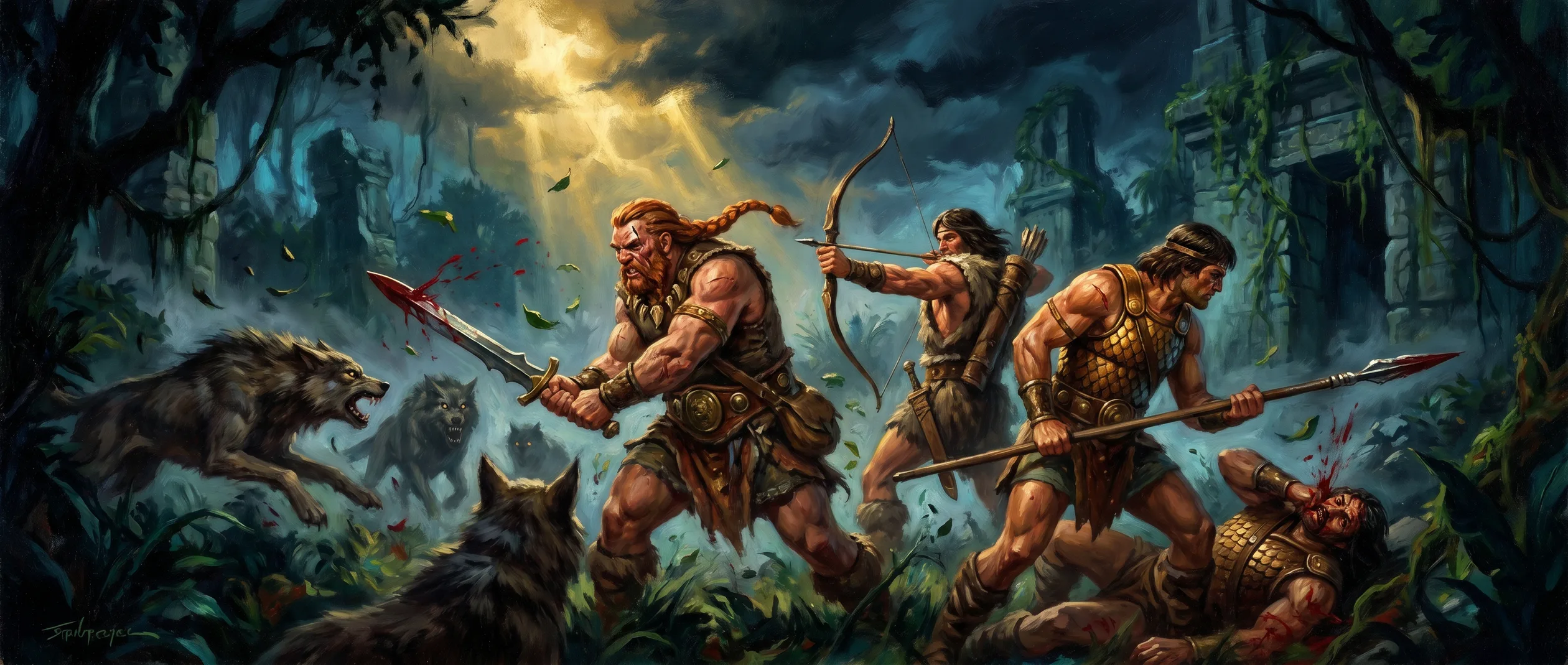
10 roles
Whose door opens
Kingdoms fall. The guilds persist.
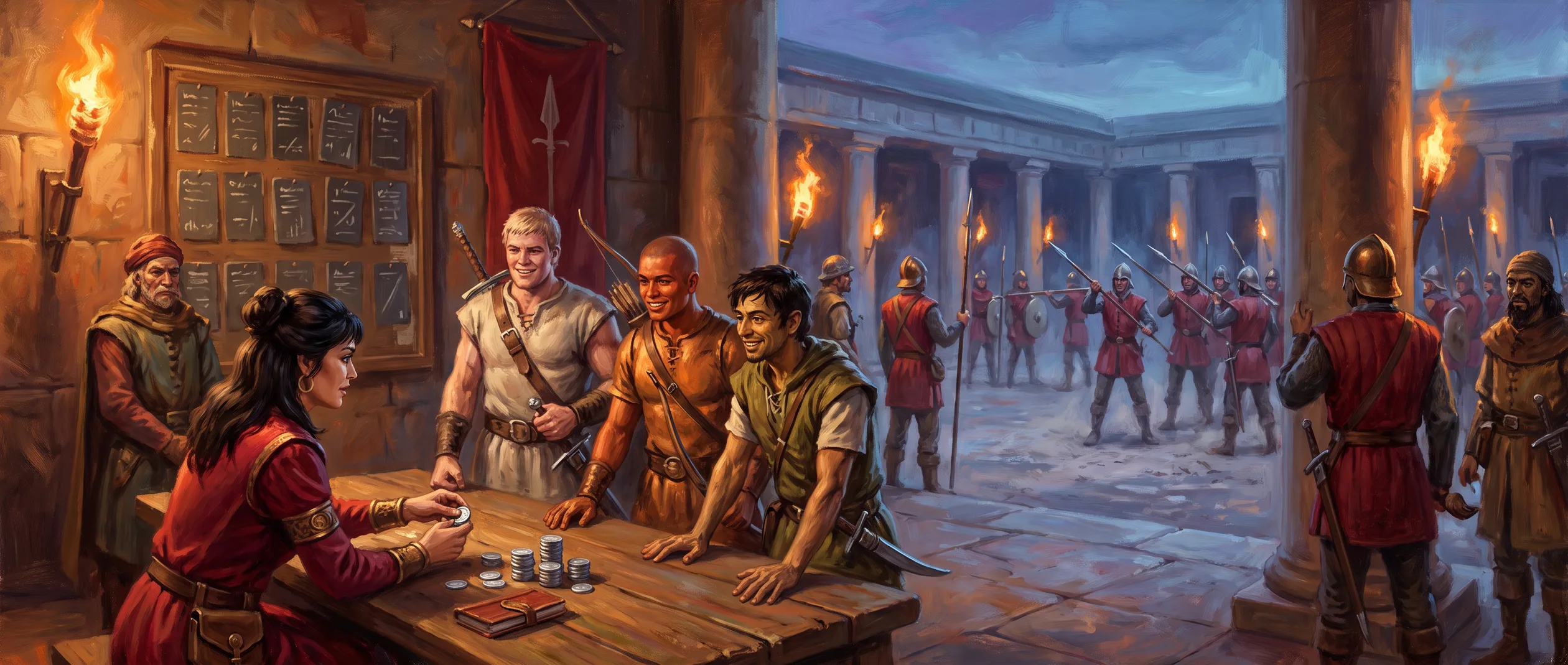
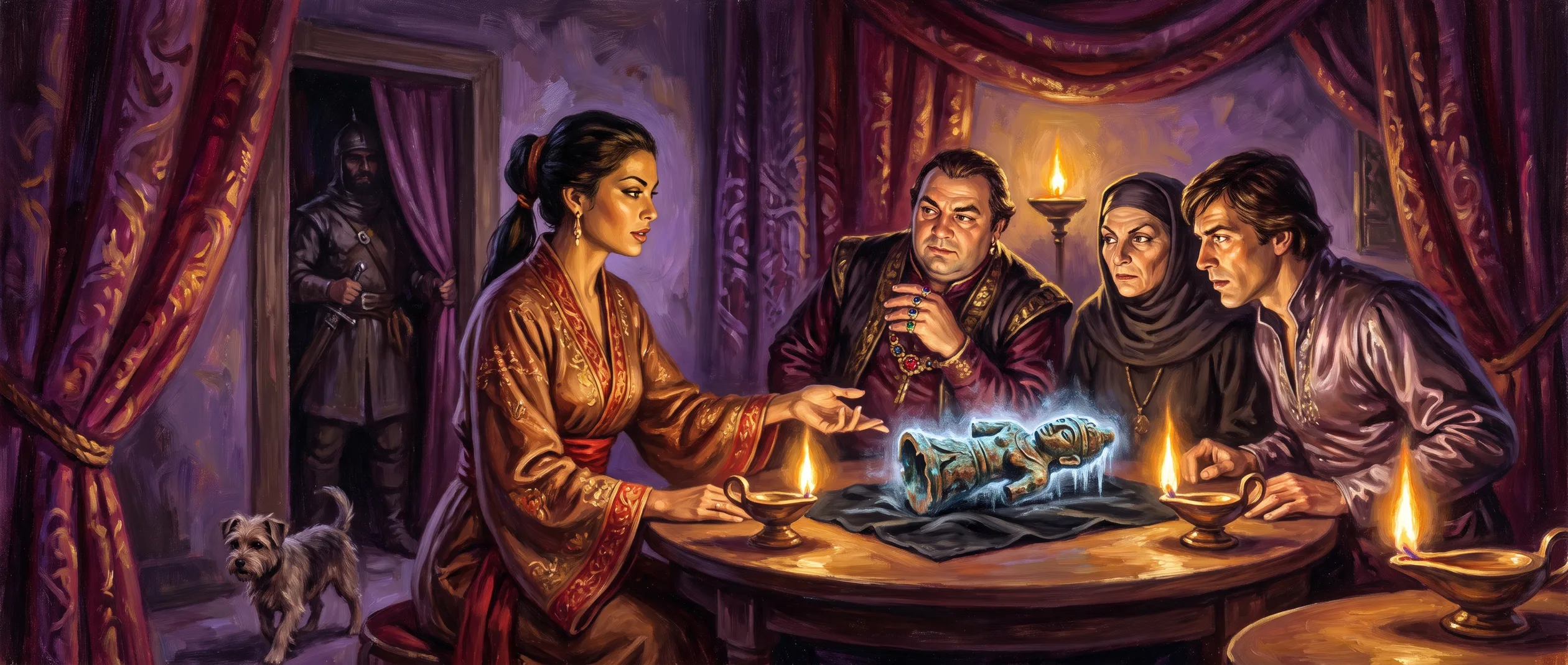
The age’s powers are not kingdoms — kingdoms rise on a strong king and fall on his heir. The powers that persist are the guilds. Join one and the belonging is real: duties kept raise your standing, rank opens halls, discounts and doors — and the old feuds are enforced: the Veiled Hand and the Coil will never share you.
Beneath the great companies the age is loud with lesser blades: the Iron Tercio, cheaper and crueler, honoring the letter of any contract while strangling its spirit; the Thousand Hooves, who will not fight on foot and will not cross running water under arms; the Ashen Company, who take the work nobody posts openly; and the Chainfleet, the slaver fleet that buys from every war it can find — and starts the ones it can’t. The trade’s customs hold anyway: ransom is sacred, a priced prisoner is a protected one, and the dead of any company go home with their swords.
The economy under the economy
The deep past is never sold — only lent at interest
The ruins hold the age’s treasure. This is what happens to it after you climb out. The collector houses buy beauty and bragging rights — best prices for the displayable, no appetite for anything that whispers. The temple houses buy things to BURY THEM AGAIN — the one buyer who pays you to make a thing disappear. And the Coil does not buy: it reclaims — politely first, then patiently, because it is older than the map and can wait for your grandchildren.
Half the “serpent-bronzes” in the silk markets were cast last spring in a Velessi backyard. The real deep pieces authenticate themselves: serpent-script that hurts to read aloud, bronze that stays cold in the sun, the way dogs leave the room. And some cargo is taboo — the trade calls a piece that kills its owners in order a WIDOW, and a widow’s price drops with every funeral until someone buys it for the Coil’s asking. Grave-goods ride under grain, never with pilgrims.
Three doors to market: the Hand’s fences, the prize auctions of the neutral ports, and the quiet rooms of the silk palaces, where a piece is shown to three bidders who pretend not to know each other. And one door you never signed for: the Coil’s final offer arrives as a crate with honest papers and unbroken seals — and some nights later the buyer who refused them is dead in a locked room, and the crate, opened before witnesses, is empty. The trade calls these gifts. The Coil accepts returns. It is, after all, a polite organization.
The arsenal
Arms, and what they cost
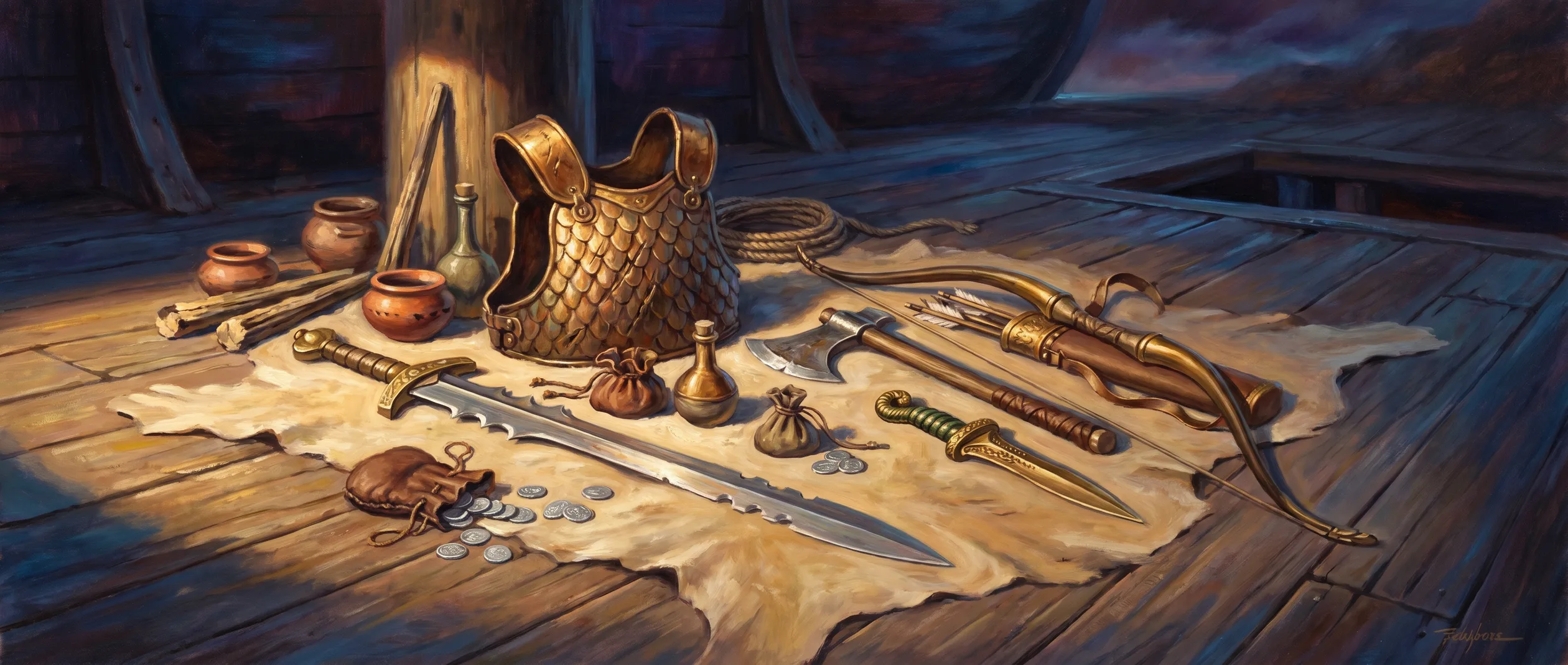
Real rows from the engine's own tables: the dice are the dice, the prices are the prices. Your gamemaster cannot fudge them, and neither can you.
The trade of the age; it settles most arguments south of the hills.
A hill-country answer to city manners.
Steppe-made recurve; death rides cheap at a hundred paces.
Temple-bronze of the old empire. The things below remember it.
Coat a blade and it counts as sanctified for the fight.
The age’s good answer; the panoply of kings costs nearly three times as much.
… and 135 more catalogued pieces in play.
The dark below the age
What the serpent-kings buried, they buried for a reason
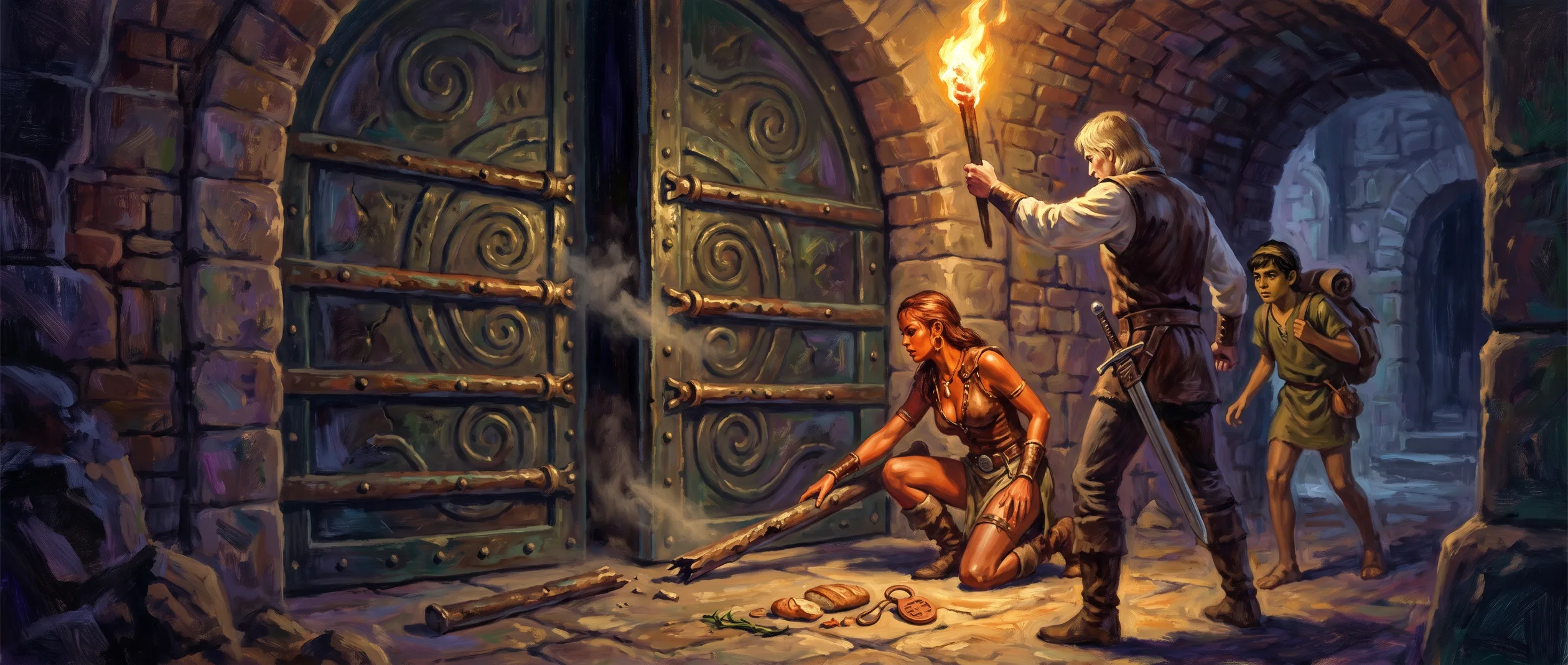
An age ago, something that was not human ruled everything worth ruling. The oldest temple inscriptions call them the serpent-kings: a crowned race that raised cities before men had fire, bound the Outer Dark into bronze and stone, and kept humanity the way men keep cattle. Their empire did not fall to a hero — it rotted from inside across a thousand years, until men with bronze spears walked into half-empty cities and took them. Most people believe none of it. But the ruins are real — under every city worth the name, out in the dunes, drowned in the deltas — and the things that sleep in them did not all die.
The deep places answer to the Outer Dark — the thing-behind-things the serpent-kings bargained with. It is not a god to fight; it is weather. What CAN be fought: its instruments — tomb ghouls, grave-wights, bronze guardians still running their last order, demons worn thin by centuries, and the Hollowed, which is what is left of a person the dark has collected whole. Every one has a weakness a prepared crew can buy or earn.
A crew that works the tombs is on the dark’s ledger — that is what drives the whole genre. Doom climbs act by act, and at ten the dark collects: a hollow thing wearing their face, a night-walk into the nearest deep place, or a promotion — a knife-priest, a Voice, a thing the campaign now deals with by name. And the age has an immune system: the Mbezi witch-finders, who can smell the dark’s hand on a traveler at the city gate. They are right about the danger. They are not always right about the person — a tomb-breaker two vaults into an honest salvage carries the same mark as a knife-priest.
The opposition
What hunts you
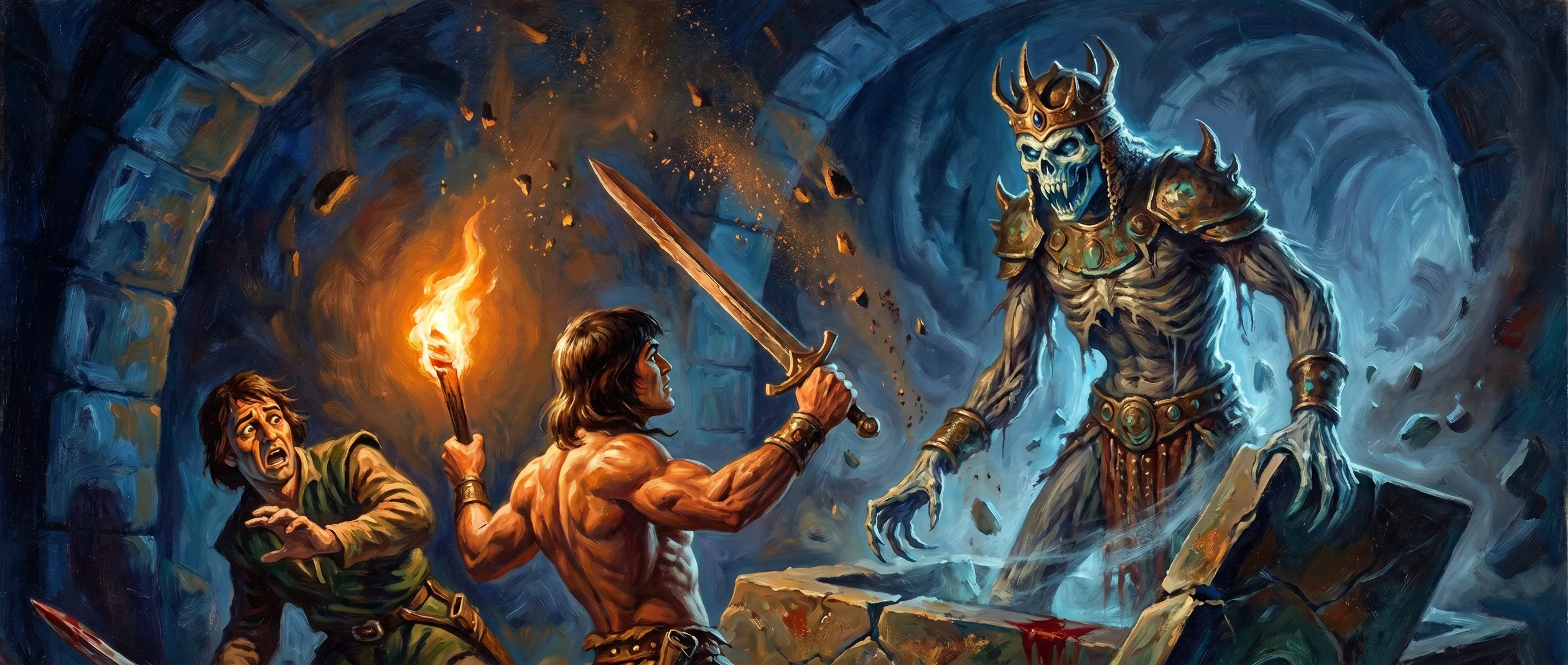
Every foe is statted before the fight starts; what your party learns about them is recorded, hunt by hunt.
Men with knives. Fight them like men.
The god’s spawn: it grapples first and squeezes after.
The cult’s speaking shadow; the knife-priests answer it.
A construct that ignores plain steel; only the old bronze bites.
It knits shut unless you bring bronze or fire.
A crowned thing that remembers its empire.
… and 53 more in the bestiary.
The silent gods
Temples on every street, and not one answered prayer
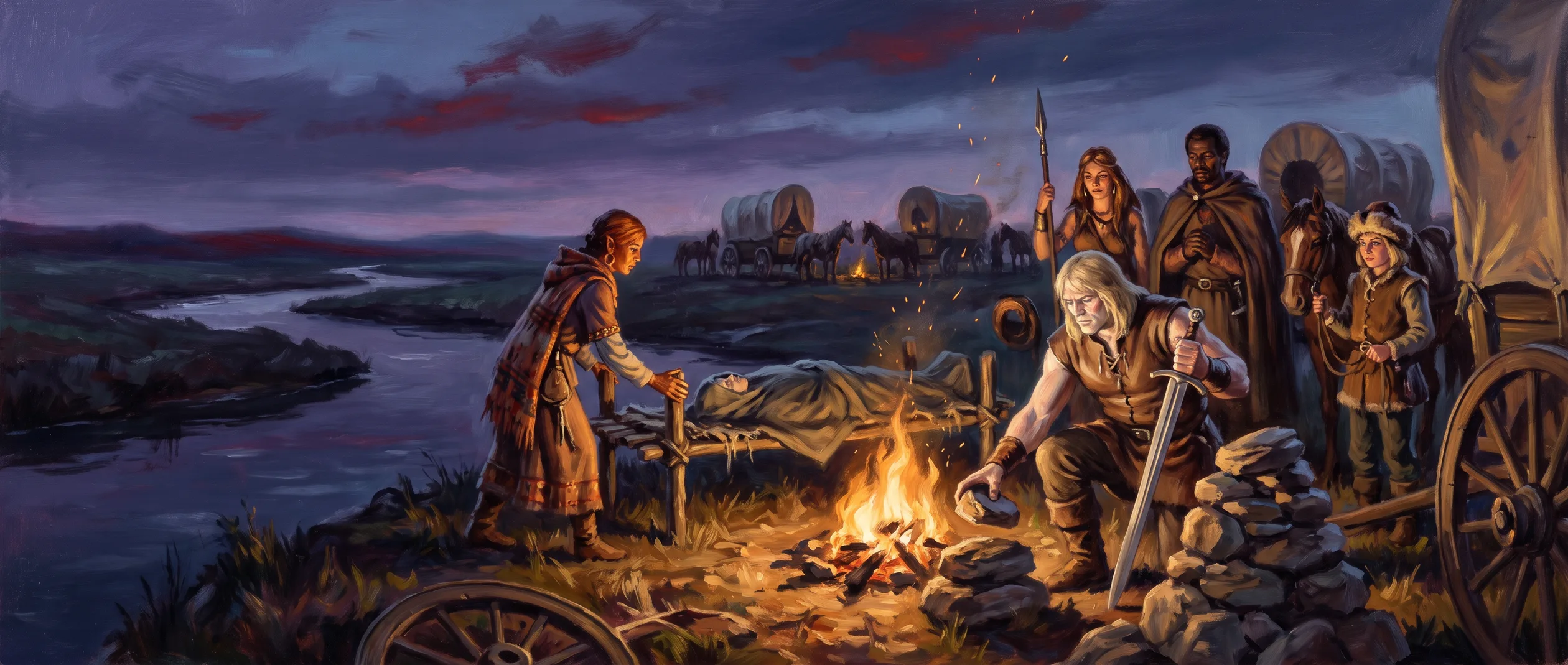
The gods of the Brazen Age are silent — no miracles on schedule, no answered vows. Whether they are dead, asleep, or simply done with men is the age’s open theological wound, argued in every wine-shop. What a temple actually is, is politics: a landowner, a money-lender, a keeper of records and a maker of kings — a guild with incense. Its treasury is the age’s oldest bank; its true monopoly is the WITNESS — an oath here is enforced by audience, not heaven, and a known oath-breaker’s word is worthless in every market on the sweep.
And when a miracle does happen — a weeping idol, a plague lifted on schedule, a god that answers in one village only — every one is a trick, a monster, or the Coil wearing vestments. The rule that keeps the world honest: the gods never answer. The moment something does, reach for steel, because whatever is listening is not a god.
None of the tellings is the world’s truth — the gods are silent on this above all. All of them are true at the fire where they are told, and the sweep’s best funerals are two tellings meeting over one body.
Begin a Serpent Throne campaign
Connect lorewend to your AI, make a character, and tell the gamemaster you want Serpent Throne. The free tier plays a full campaign.